The asset inventory
Helping Your Boyfriend is a Unity game running on Naninovel, and every picture it can show you is listed in two asset maps inside the shipped web build. The first file holds 381 entries and the second holds 184. Merge them, remove the duplicates, and you get 431 unique asset keys. That is the whole art department of the game, in one number, and every image in this guide comes from that list rather than from guesswork.
The keys are paths, and the paths tell you a surprising amount. Backgrounds live under naninovel/backgrounds, characters under naninovel/characters, music and effects under naninovel/audio, and voice lines under naninovel/voice. Everything else sits at the top level in its own folder: ui for the interface, doll and doll-layer for the toy you take apart, plus video, dreamframes, bathtime and font.
| Folder | Entries | What it holds |
|---|---|---|
| naninovel/backgrounds | 105 | Every room, variant, effect frame and placeholder |
| naninovel/audio | 92 | Score, ambience, doors, footsteps, the rest |
| naninovel/characters | 66 | Adrian, Ian, Oliver, your hands, one rat |
| naninovel/voice | 65 | Spoken lines, with takes |
| ui | 40 | Interface art and the mini-game icons |
| doll | 25 | The bear you pull apart |
| doll-layer | 22 | Layered doll pieces and reskins |
| video | 4 | Openings and end credits |
| dreamframes | 4 | Watercolour dream sequences |
| bathtime | 3 | The bath-time screens |
| font | 3 | Two of the three faces are used at runtime |
Look at that table again and one number stands out. Forty interface elements, twenty-five doll parts and 431 assets in total — but only 66 of those assets are a person. Adrian alone takes 30 of them, Ian takes 27, and Oliver takes three. The rest of the game's budget went into rooms, sound and furniture, not faces. That imbalance is the single most useful thing to know about the art direction, and the rest of this page unpacks it.
There is also a small but revealing detail in how the two maps overlap. The second file is called the all-assets map and it is smaller than the first, which sounds backwards until you notice that the two files are not two halves of the library. They are two snapshots taken at different times, and the overlap is where the interesting deletions live: things the developer removed from the live set but never deleted from disk.
What this page is for
By the end of this page you will be able to open the game's own data and recognise what you are looking at. That matters because this build was never polished into a tidy release. It still carries prototype sketches, misspelled file names and unfinished stand-in frames, and a player who knows the system reads those artefacts as evidence rather than as sloppy work.
The 105 backgrounds
All 105 background entries live in a single folder, naninovel/backgrounds/mainbackground. One folder for every room, every lighting variation, every character splash and every unfinished placeholder in the entire game. That single fact explains why the background count is so much higher than you would expect from a game this short, and it is also why the number needs a caveat: 105 files does not mean 105 finished scenes. Of those, 23 are placeholders, which leaves 82 usable frames.
The 82 split into recognisable families. The house takes the largest share: the living room bg-living-room, the hallway frames bg-hallway1, bg-hallway2 and bg-hallway-up, the staircase bg-stair-basement and bg-up-basement, the front door in three distances bg-front-door, bg-front-door1 and bg-front-door-close, Adrian's own room bg-adrian-room, the dressing table bg-make-up, the room behind the locked door bg-secret-room and the exterior of the Winchester house bg-winchester-house1 and bg-winchester-house2. The house you spend the whole game inside is drawn with the most care and the most variants.
Your own room gets its own set, and the naming here is the first real clue that the build was assembled in layers. The finished daylight bedroom is mc-room-day-1: pastel, a pink door, a wheelchair, shelves of small toys. The names mc-room-day, mc-room-day-down, mc-room-night, mc-room-bed-body, mc-room-leg-move and mc-room-real all belong to that room too, but every one of them is a placeholder. The only other real ones are mc-room-door, mc-room-ian-look and mc-room-stand, and that last one is the finished replacement for the placeholder mc-room-real.
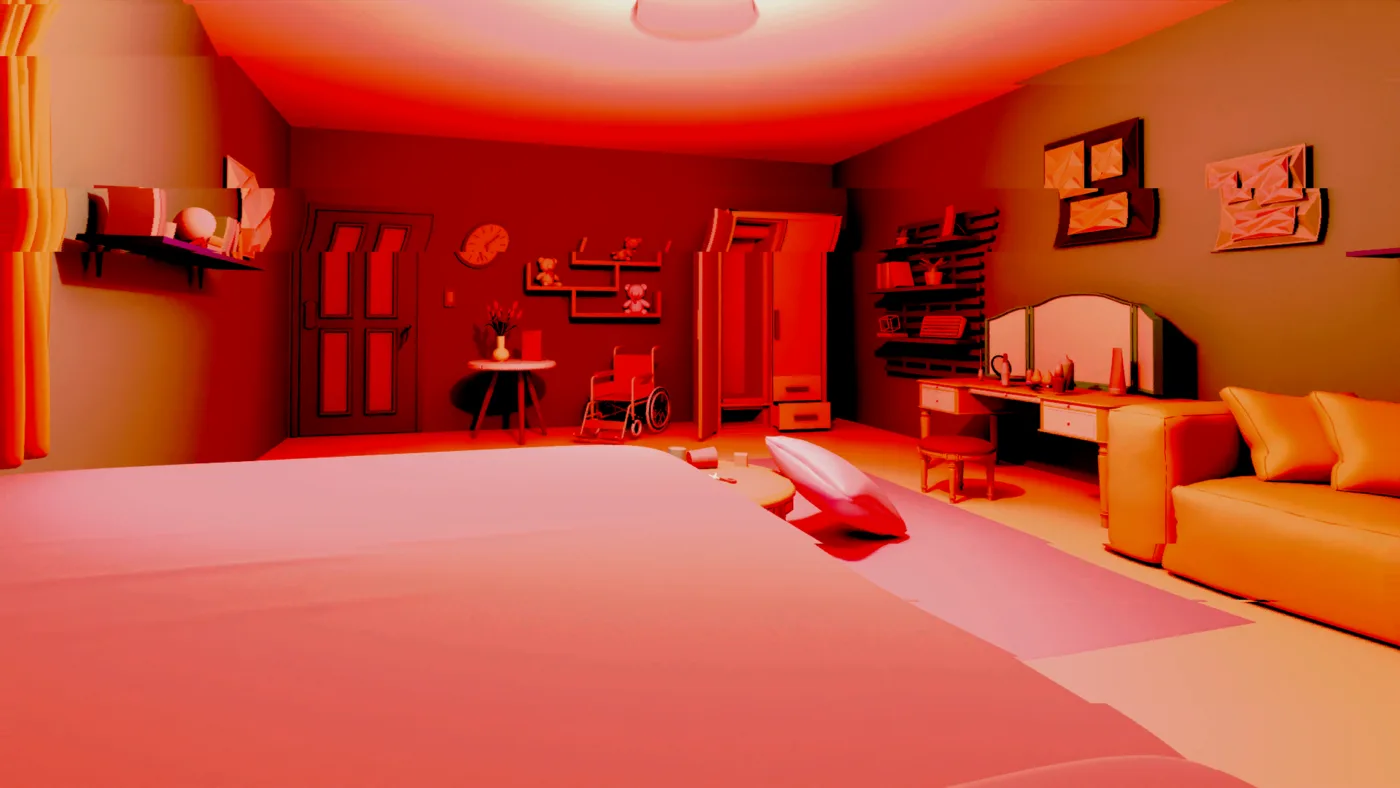
Then there is the frame that changes the temperature of the whole game: bd-room-real-finish. Same room as mc-room-day-1, same framing, same pink door and the same shelves, but flooded with red light and Adrian sitting on the bed. The room you slept in becomes a different room entirely without a single wall moving. That is the whole visual grammar of the game in one pair of files.
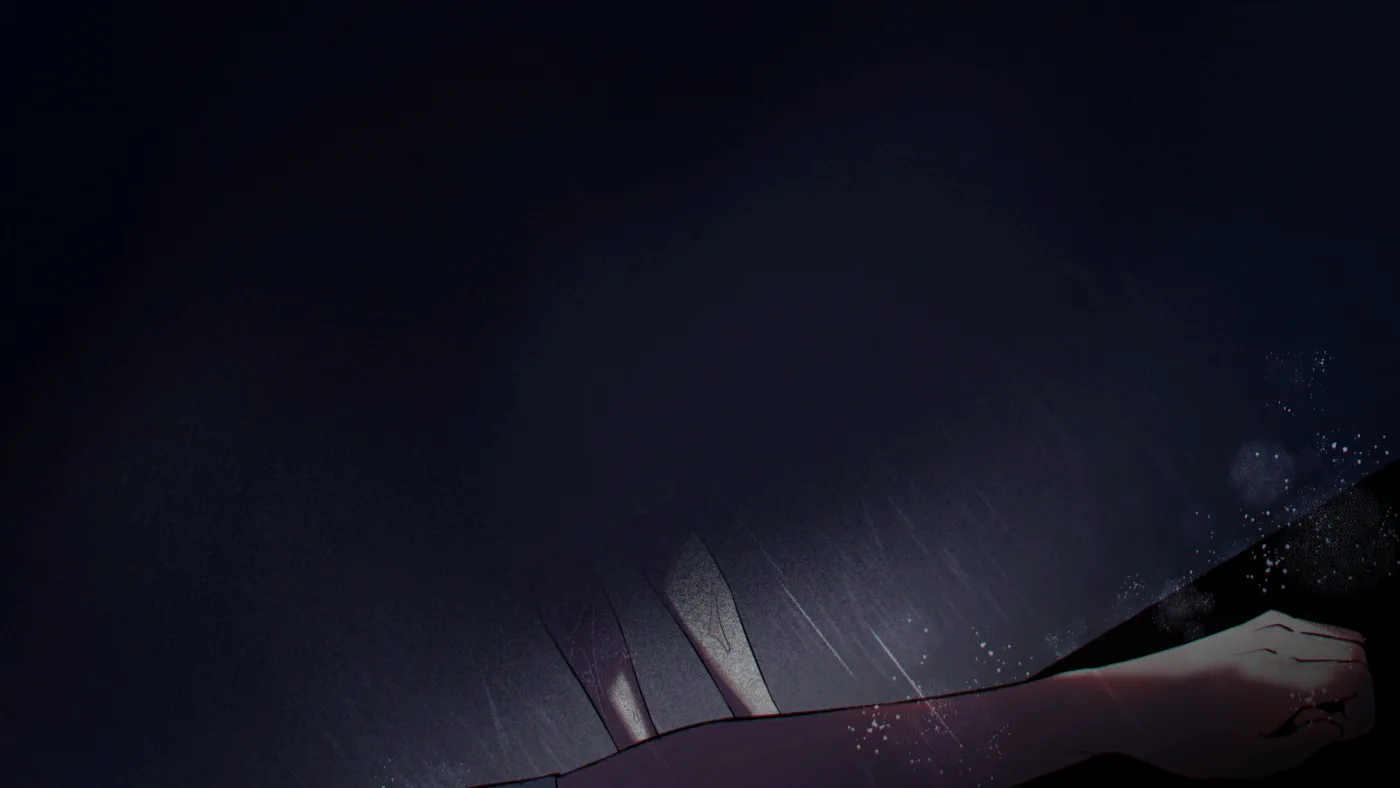
Two more families deserve a mention because they are easy to mistake for backgrounds when you are reading the file list. The attack set contains fifteen frames whose names start with attack-, plus adrain-mocking. These are not rooms. They are full illustrations of Adrian in a white coat against flat colour fields, one per emotional register: attack-cold, attack-gleeful, attack-manic, attack-mocksweet, attack-neck, attack-rant, attack-smirk, attack-smirk2, attack-stabbed, attack-stabbed-pull, attack-touch-hand1, attack-touch-hand2, attack-inject1, attack-inject2 and attack-jumpscare. Because they live in the background folder rather than the character folder, a naive count of the cast's artwork understates Adrian by fifteen drawings.
And then there are the quiet utility frames: black and black-bg are genuinely solid black, and prologue-bg is a flat pink field. Those three are deliberate colour fields, not missing art. main-menu-prototype is a rough pencil sketch that the finished build kept around, and img_6517 is a file that got shipped before anyone named it.
The four glitch frames
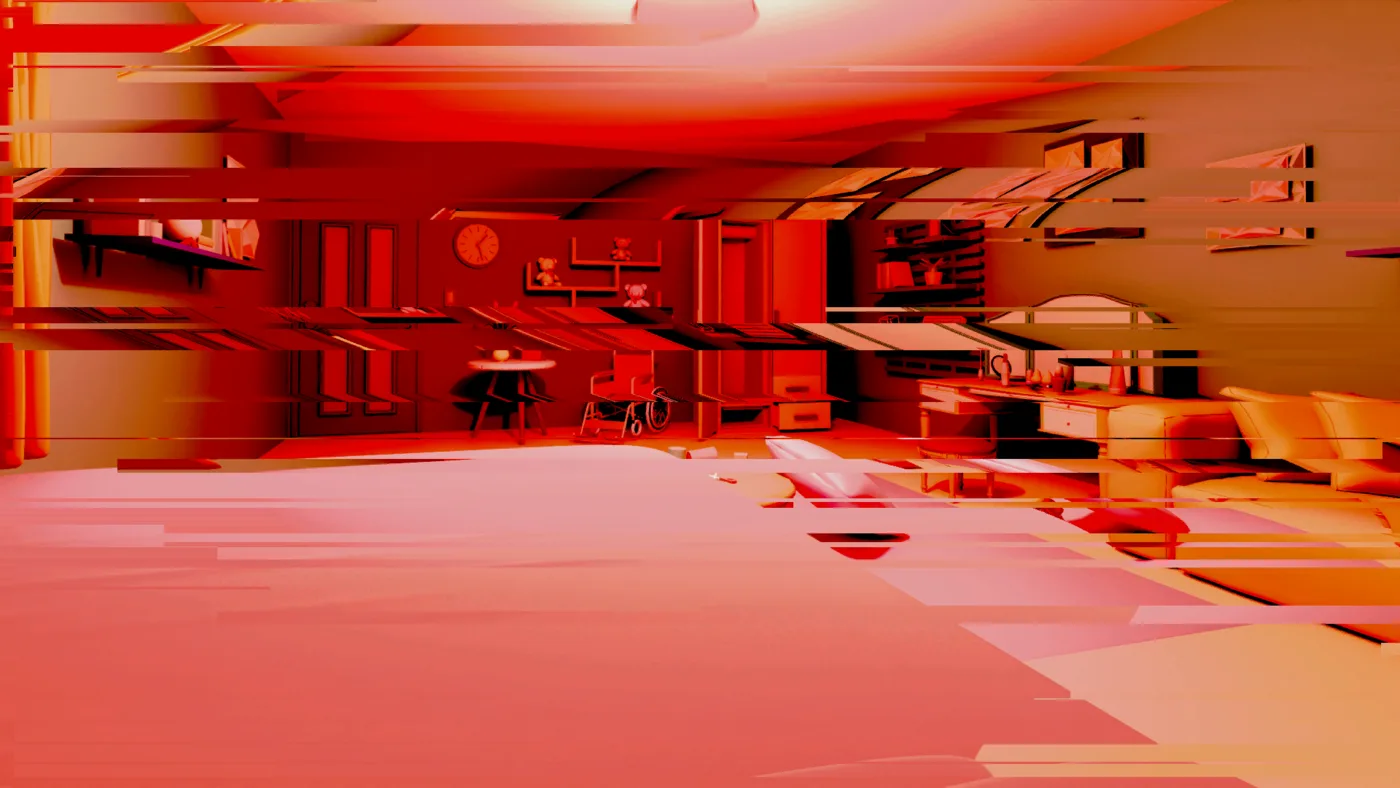
Four backgrounds share a prefix: bg-real-room-glitch-1, bg-real-room-glitch-2, bg-real-room-glitch-3 and bg-real-room-glitch-4. They are not four rooms. They are one room, the red-lit interior you know from bd-room-real-finish, captured four times as it degrades.
The escalation is deliberate and easy to read if you see them in order. Frame one is almost clean. Frame two is visibly displaced sideways, as if the image has torn away from the frame it was drawn in. Frame three is smeared into horizontal bands. Frame four is the worst of the four. Nothing new is introduced between them — the same furniture, the same red wash, the same room — so the only variable is the corruption itself.
What makes this a story element rather than a visual gimmick is that frame one is wired into the doll twist. When the twist fires, the game swaps the ordinary room for bg-real-room-glitch-1. That means the glitch set is not decoration the artist left lying around; it is a load-bearing part of the build, and the other three frames are the escalation ladder built alongside it.
The nine pieces named as CGs
Only nine of the 105 backgrounds are explicitly called CGs, and they are the only images in the game that behave like illustrations rather than scenery. The list is cg-adrain-university1, cg-adrain-university2, cg-adrain-flower 1, cg-car-female, cg-car-male, cg-car-female-ian, cg-car-male-ian, cg-ian-raining-relieved and cg-ian-feet.
Two things about that list are worth pausing on. The first is that the CGs live in the same folder as the backgrounds, which is why a plain folder count understates how much illustration the game actually ships. The second is that the names contain the game's own two little naming problems. The prefix is spelled adrain rather than adrian, and one of the university frames has a stray space before the number: cg-adrain-flower 1. Both are in the shipped filenames, so both are correct as written here.
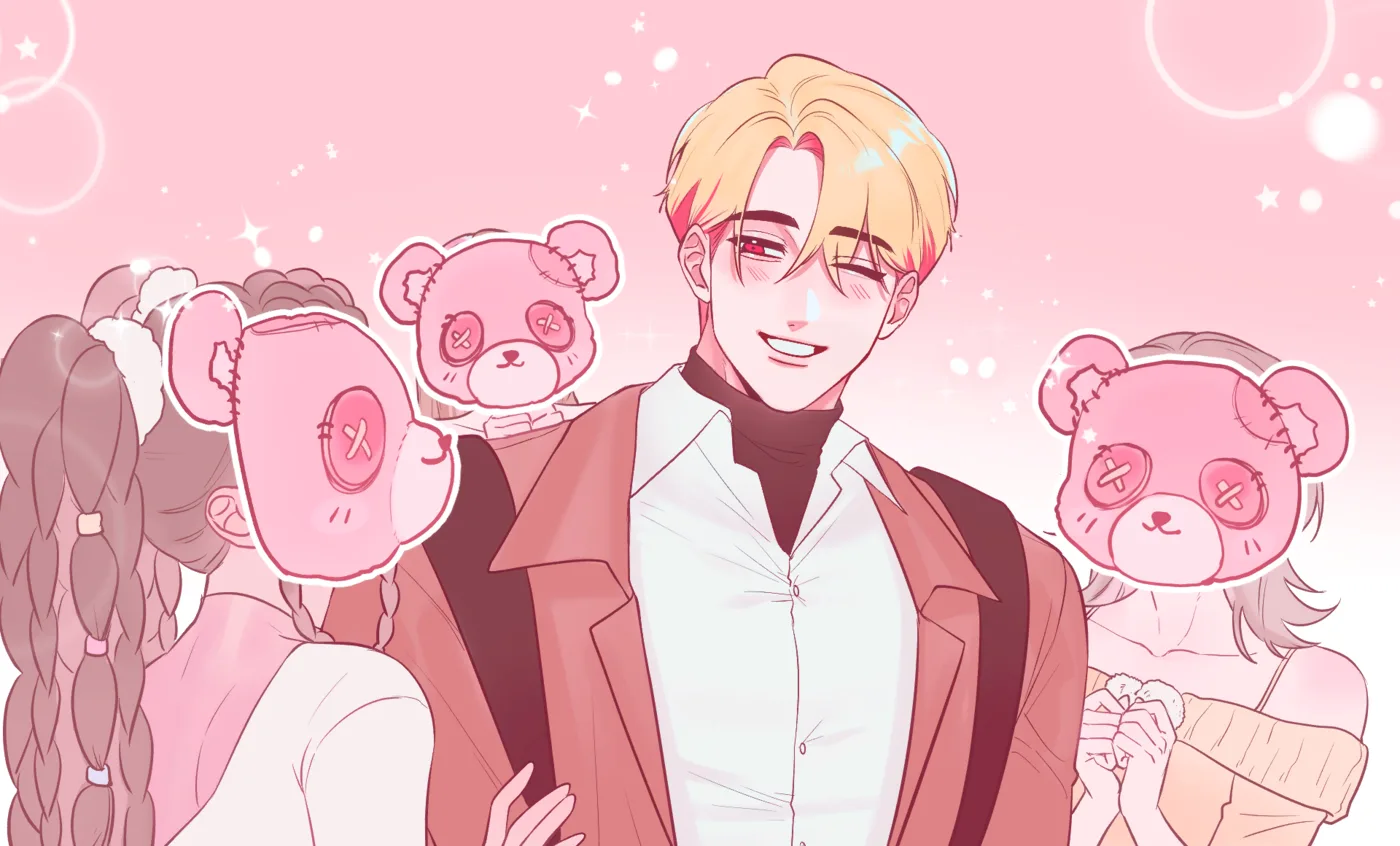
The university pair is the game's most painterly material, and it is where the palette question gets answered. Adrian is drawn in soft pink tones with masked figures standing behind him, and the bear in his hand is not the bear you are asked to take apart. That is not a small detail. The whole game runs on a rose-and-cream palette with a hard red reserved for violence, and the university CG is where the soft version of that palette is established before anything goes wrong.
The car frames come in a four-way split: cg-car-female and cg-car-male for the two body-type variants of your character, and cg-car-female-ian and cg-car-male-ian for the same two variants with Ian in the car. That the artist drew four versions rather than reusing one is a good sign of how much attention the endings received. The remaining two, cg-ian-raining-relieved and cg-ian-feet, are the quieter Ian material, and if you have played his route you will know exactly where they land.
The 66 character sprites
Now the other half of the art: the people. The character sprites are split into five folders named after the cast, and the counts are 30 for Adrian, 27 for Ian, 5 for your hands, 3 for Oliver and 1 for a dead rat. The folders are single letters, a, i, hand, o and rat, so you can guess which body is which from the asset path alone.
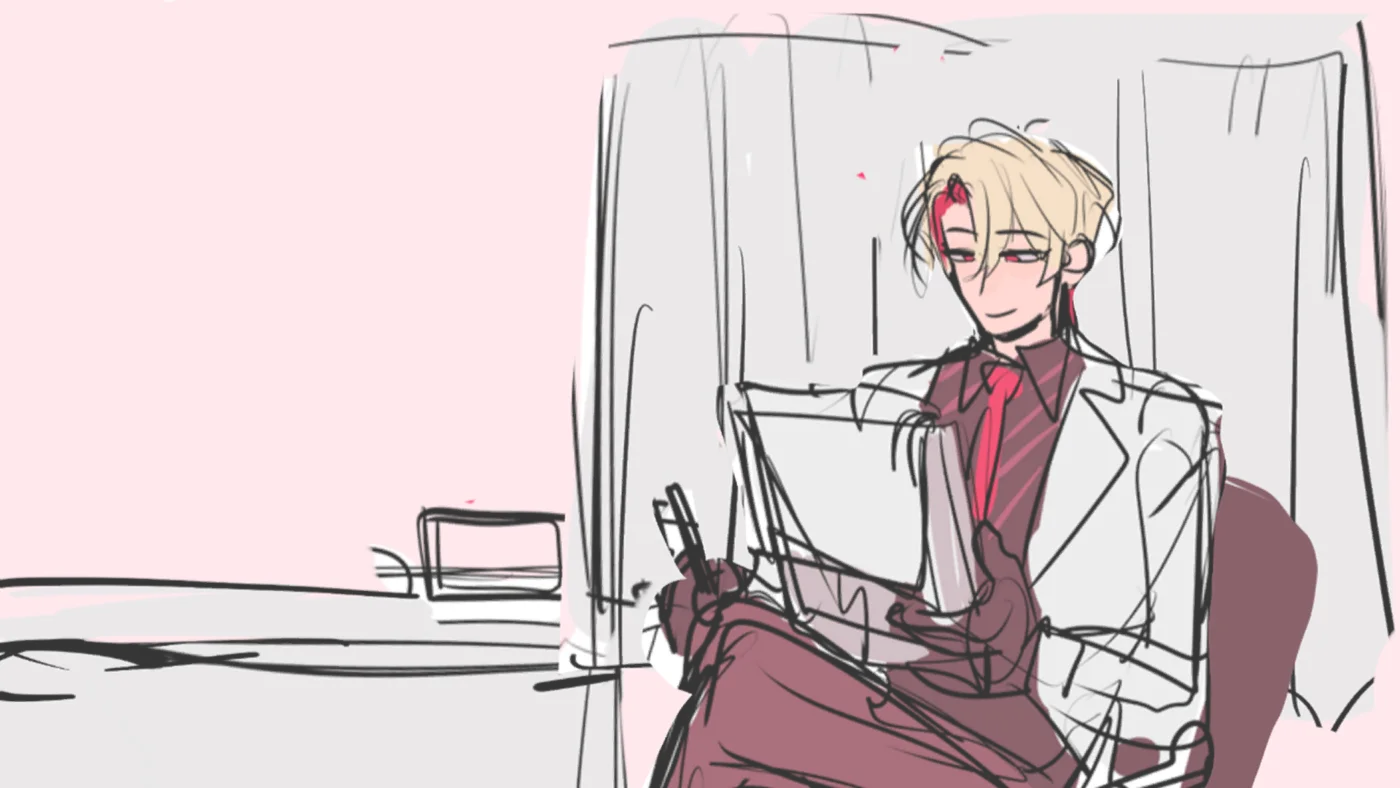
Adrian's thirty split into three groups. Ten are makeup and phone poses: closer-curious, makeup-gloom, makeup-heavy-gloom, makeup-heavy-kiss, makeup-heavy-sullen, makeup-heavy-tease, makeup-kiss, makeup-sullen, makeup-tease and phone-talk. Two are the bath-time frames, sit-bath-happy and sit-bath-smile. The rest are the big sitting set, which is the one that matters for how the game reads.
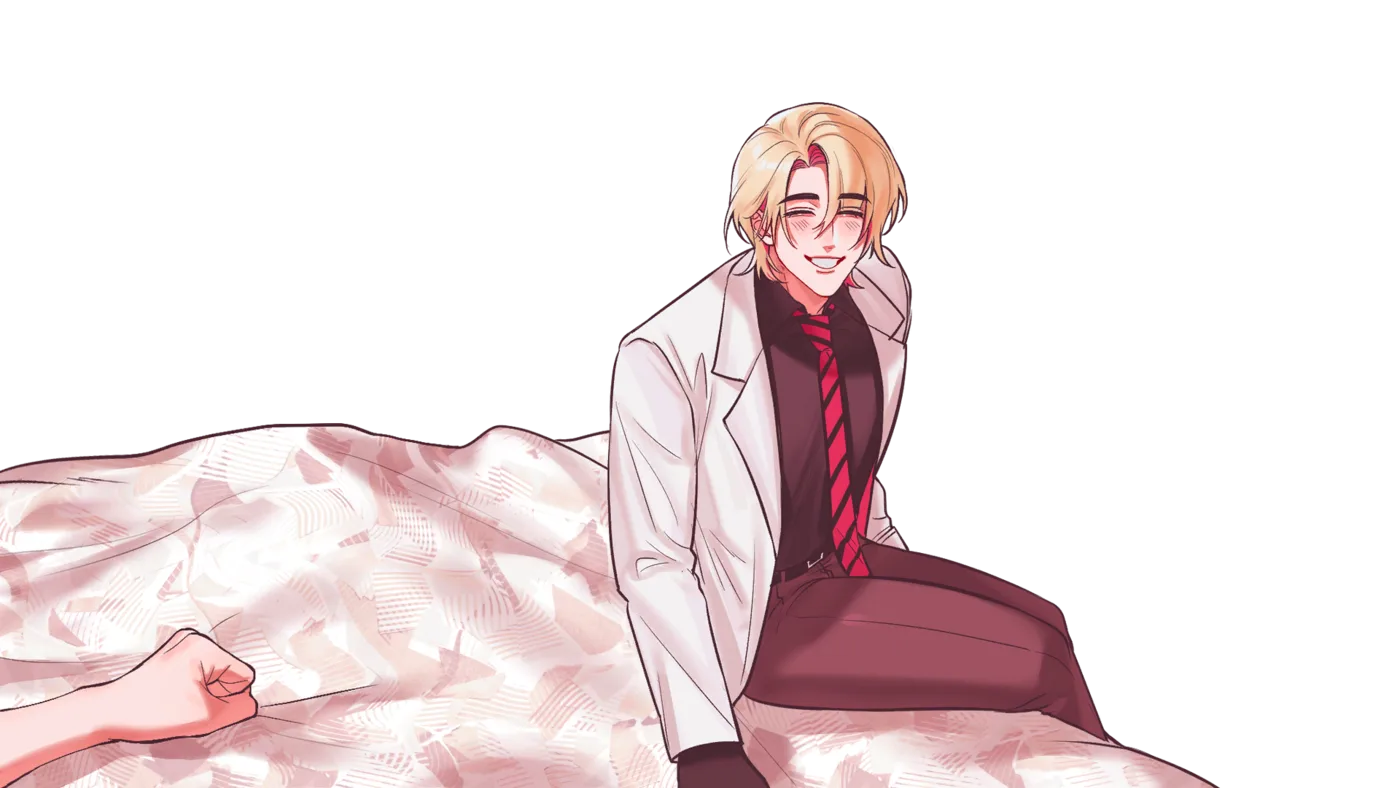
The sitting set is where the naming convention becomes visible, and it explains something about how the build was made. Seven poses exist as pairs: sit-happy and sit-happy-real, sit-sad and sit-sad-real, sit-serious and sit-serious-real, sit-serious2 and sit-serious2-real, sit-smile and sit-smile-real, sit-surprise and sit-surprise-real, sit-tease and sit-tease-real. The plain name is the earlier drawing. The -real suffix is the version the finished build uses for the actual scene. Only the suffixed version reaches the player, and the plain one stays in the build as dead weight, in exactly the same way the placeholder backgrounds do.
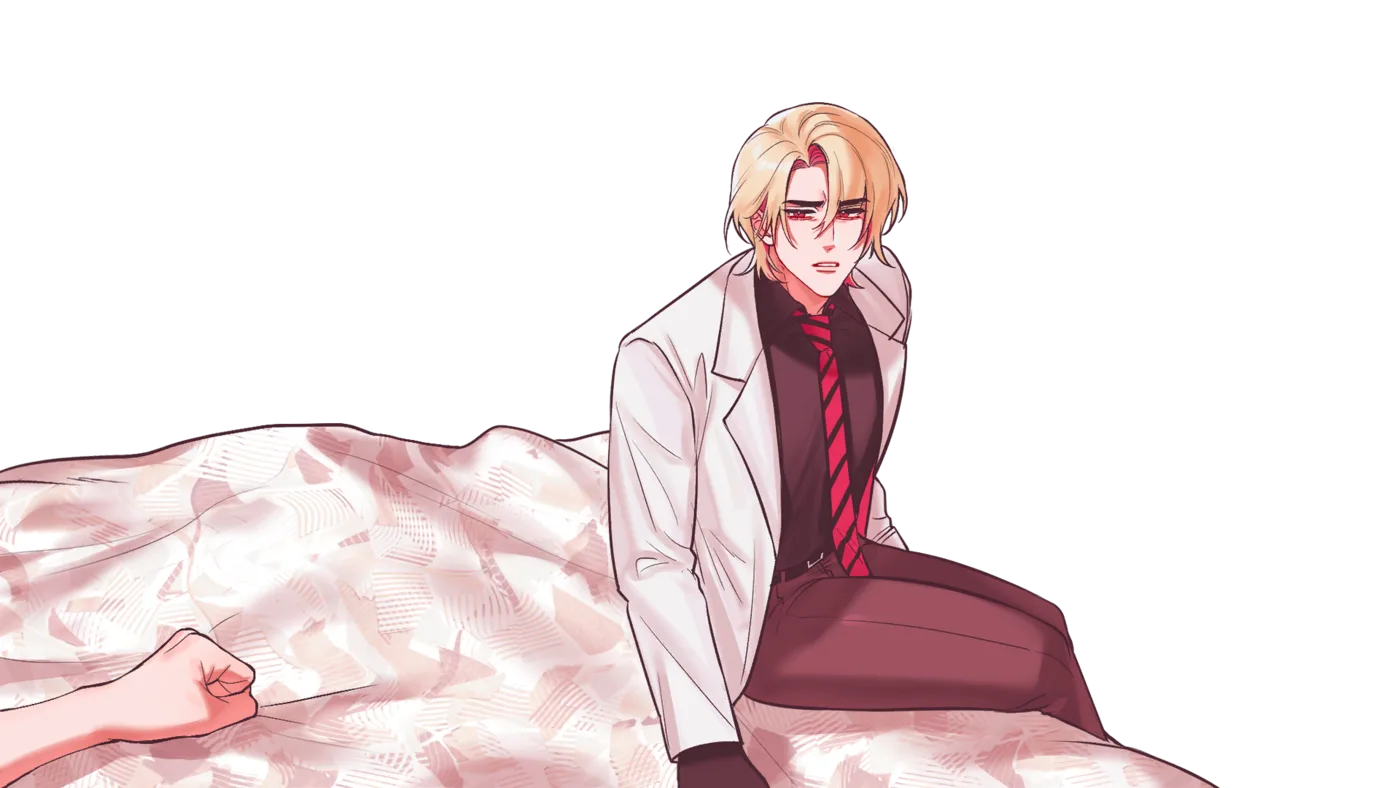
That pairing is the practical lesson of the whole sprite folder. The body is expensive and the face is cheap. The artist drew one body per situation and swapped the expression on top, which is why Adrian has thirty images but only about twenty distinct body poses. When you are reading the game, the expression change is the dialogue.
Ian's twenty-seven are organised even more clearly, and they split into four visible families: the look set for the interior conversations (look-stare, look-smile, look-sad, look-shock, look-blush, look-happy, look-explain), the outside set for the street scenes (outside-angry, outside-breaking, outside-breaking-2, outside-cold, outside-crying, outside-inject, outside-mocking, outside-shaking, outside-shock, outside-slap, outside-smile, outside-uneasy), the sit set (sit-blush, sit-hi, sit-nervous, sit-serious, sit-smile) and three jumpscare frames, jumpscare-1, jumpscare-2 and jumpscare-3. Read those prefixes as a spoiler: three jumpscare frames means there are three separate moments in the game where Ian lurches at the camera.
Your own hands get five entries, door, med, number, number-smudge and pet. The camera is the player, so your hands are the protagonist. Two of those five are the phone digits written in ink on your arm, one clean and one smeared — the game fades them across the run, and the number-smudge frame is how it shows that. And one single sprite, rat/dead, because the game needed exactly one dead rat and never needed a live one.
Oliver and the three-drawing problem
Oliver Freeman has three sprites in the entire game: help-firm, help-serious and help-worried. That is the whole folder, and every one of the three is him helping you. Compare that with Adrian's thirty and Ian's twenty-seven, both of which include blushes, jokes, tears, threats and idle poses. Oliver is the only speaking character in the game who never changes posture and never changes expression beyond degree.
There are two ways to read that, and both are true at once. The first is structural: Oliver appears late, briefly, and mostly in the police-station material, so he was scoped to a small number of scenes and the artist drew to the scope. The second is thematic, and it is the more interesting one. Every other character in the game is drawn with a face that moves, because the whole story is about people whose feelings you have to read. Oliver is the one person whose face is calm and kind while everything else falls apart, so the art keeps him steady on purpose. Three drawings, three states of helping — firm, serious, worried — is the entire emotional vocabulary the game gives him, and it is enough.
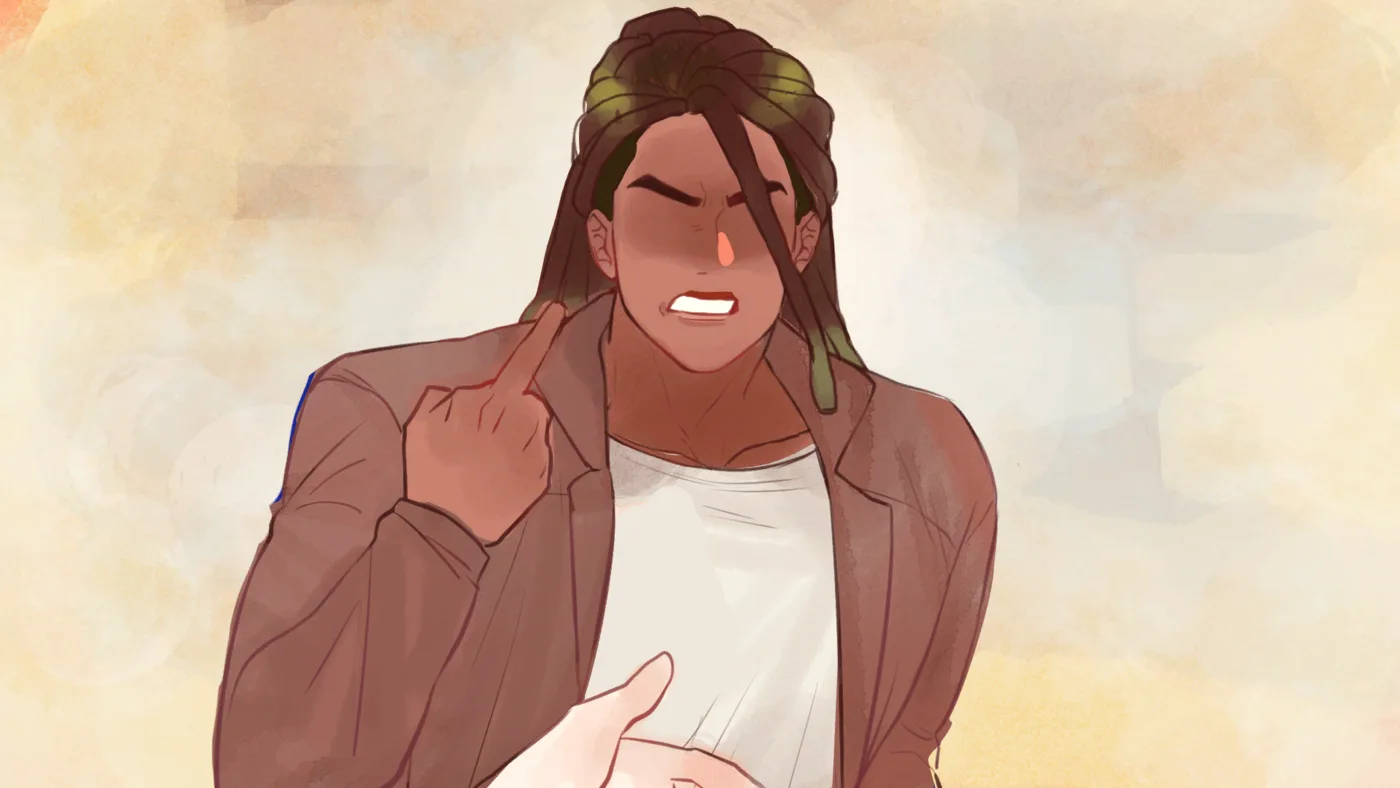
That watercolour treatment is worth a second look. The dream material in this game is not painted the way the game is painted. The dreamframes folder holds four watercolour pieces — adrian-dream-1_b, adrian-dream-2_b, oliver-dream1_b and oliver-dream2_b — and they use a completely different medium from the flat cel shading everywhere else. When you are in a dream sequence, the art style itself changes. Oliver appears in two of the four, which is another quiet hint about how the game wants you to read him.
Oliver's voice set is correspondingly small. Across the whole game there are 69 voice takes split between the three speaking characters, and Oliver's share is the smallest of the three. Adrian has 22, Ian has 34, and Oliver has 13. The man who rescues you says the least, which fits the same reading of the art.
The doll art
The teddy bear you take apart is the most mechanically important art in the game, and it is built from twenty-five pieces in the doll folder plus twenty-two more layered pieces in doll-layer. The named parts are all bear parts: bear-head, bear-body, bear-body-back, bear-body-cut, bear-cutton, bear-ears-l, bear-ears-r, bear-eyes-l, bear-eyes-r, bear-heart, bear-legs-l, bear-legs-r, bear-arms-l and bear-arms-r. There are also nine stitching pieces, bear-thread-body-center, bear-thread-body-l, bear-thread-body-r, bear-thread-ears-l, bear-thread-ears-r, bear-thread-eyes-l, bear-thread-eyes-r, bear-thread-legs-l and bear-thread-legs-r, plus bear-1-ex1 and bodyopen.
Read that list as a cutting diagram rather than a parts catalogue. The bear has a back, a cut body, and a body with its belly already open. It has a separate heart. It has stitching for every seam that could be re-sewn, which is why the threading pieces come in matched left and right pairs for the body, the ears, the eyes and the legs. The whole thing is authored as an object you can take apart and put back together wrong.
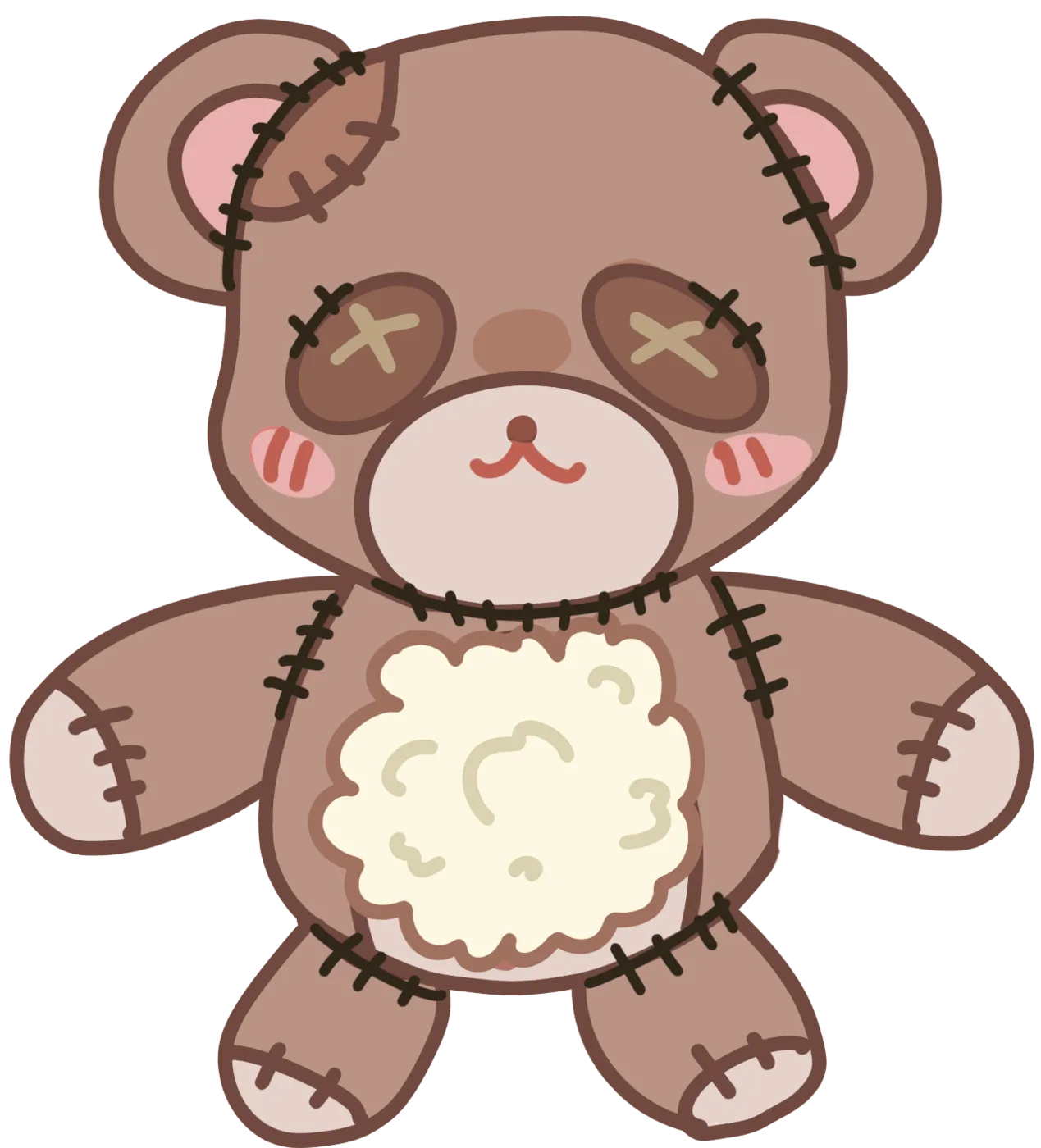
The X-shaped eyes are the single most efficient piece of character design in the game. Two crossed stitches where eyes should be, and the bear stops being a toy and becomes a thing that has been used. Combined with the heavy black seams and the belly already cut open with pale stuffing showing, the bear reads as an object that has been taken apart and reassembled many times by someone who does not care. It is Macaroni's bear. It has been handled.
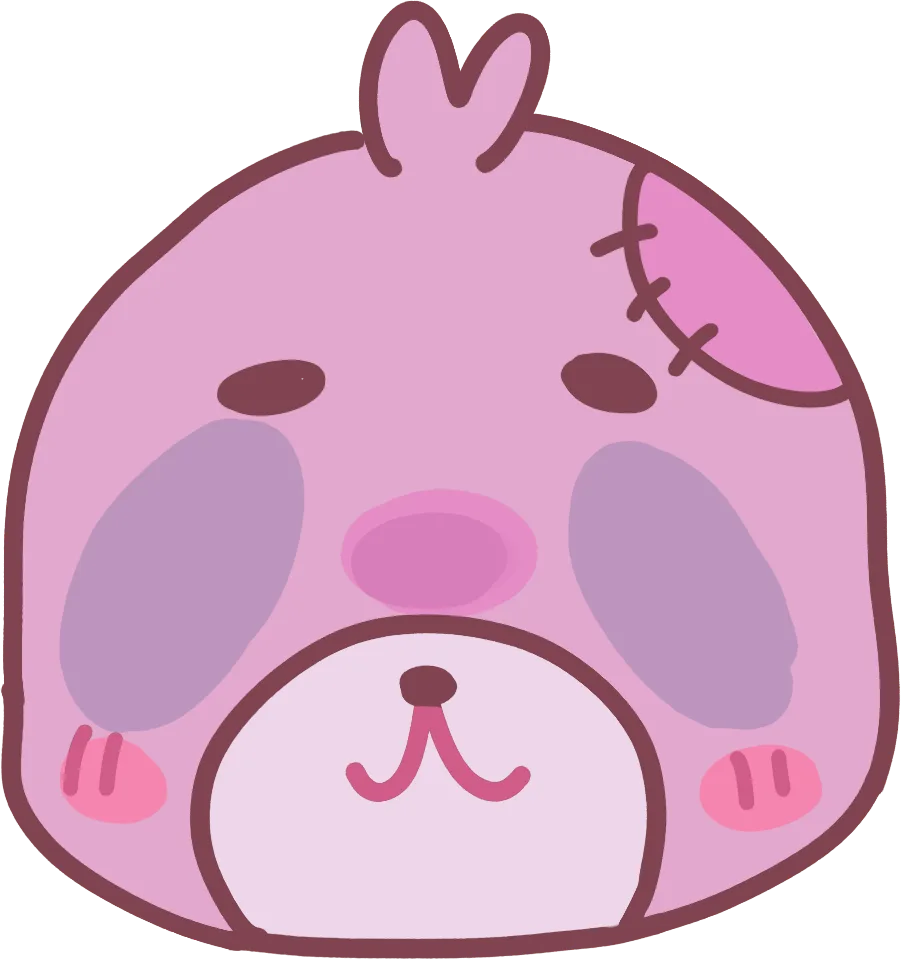
The gore variant is a reskin rather than a redesign. The bunny doll head used by the gore version has a tuft of fur, a stitched scar across one eye and flushed cheeks, but it occupies the same slot in the same puzzle. That is what the thirteen reskins and one extra piece in the doll-layer folder are for: the same toy, the same disassembly sequence, a different skin. The doll you pull apart on the later nights is not a new puzzle. It is the same puzzle made to hurt more.
The interface and the fonts
Forty interface elements is a lot for a game this small, and they fall into a few clear groups. The interface skins are ui/bg, ui/body, ui/curtain, ui/table, ui/chair_back and ui/chair_front — the room the game puts its own interface inside. The dialogue boxes are ui/text-box-light 68, ui/mc-text-box-dark, ui/text-box-bar and ui/choice-text-box, and note the stray space in that first name, which is in the shipped file exactly as written.
Then there are the stickers, ui/sticker__0002_bear, ui/sticker__0003_star1 and ui/sticker__0004_heart1, and the selection screens ui/pronouns-bg, ui/bodytype-bg, ui/body-type-fem, ui/body-type-mus and ui/eyes_open, which is where you pick your pronouns and your body type at the start of a run. ui/chibi-adrian is a small chibi drawing of him, ui/logo-main-menu and ui/main-menu-button-idel are the title screen, and ui/event-pink and ui/event-black are the two event stings.
The most useful group for a player is the mini-game icon set, eighteen files whose names start with mncg-: mncg-bear1, mncg-bear2, mncg-dino-doll, mncg-rat, mncg-phone, mncg-scalpel, mncg-camera, mncg-medicine1, mncg-medicine2, mncg-water, mncg-key, mncg-family-photo, mncg-box, mncg-gore, mncg-ian-hos, mncg-ed1 and mncg-ed2. These are the tiny pictograms that mark activities and progress points, and because there are two bear icons and two medicine icons and two ending icons, the set itself confirms the shape of the run: two dolls, two doses, two endings you can reach this way.
The font folder holds three files, inter-regular, bunny ears and boogaloo-regular. The runtime uses two faces beyond that: the label face is Boogaloo SDF and the body face is Mitr-Regular SDF. bunny ears is unused, or reserved. A hand-drawn horror visual novel choosing a rounded, slightly childish display face for its labels while the body text stays plain is a small but deliberate choice, and it is the same instinct as the X eyes on the bear.
The 23 placeholder frames
Now the part that makes this guide worth reading twice. The shipped build carries 23 placeholder frames alongside the finished art, out of the 105 background entries. Every one of them is a flat colour field with a wide black bar across the middle, and the bar has the word PLACEHOLDER and the file name burned into it in white text. They are not subtle and they are not hidden. If you see one while playing, you are not imagining it.
| Placeholder file | The finished frame for the same scene |
|---|---|
| mc-room-day | mc-room-day-1 |
| mc-room-real | mc-room-stand |
| dressing-table | bg-make-up |
| adrian-room | bg-adrian-room |
| bg-2nd-floor-landing | bg-up-stairs |
| dino-doll | ui/mncg-dino-doll |
The remaining seventeen have no direct finished twin and are simply dead weight in the build. The full list of all 23 is adrian-room, bg-2nd-floor-landing, bg-attack-pink, bg-attack-red, bg-door-basement, bg-door-basement2, bg-hospital-room, bg-living-door1, bg-locking-door, bg-stairs, coffee-shop-1, coffee-shop-2, dino-doll, dream-watercolor, dressing-table, front-door-hall, living-room, mc-room-bed-body, mc-room-day, mc-room-day-down, mc-room-leg-move, mc-room-night and mc-room-real.
What to do when you hit one
Nothing breaks and nothing is missing. Every placeholder has a finished counterpart in the build, and the scene will play out normally either way. If a placeholder shows up mid-run, use it as a signal rather than a bug report: it usually means the script reached for an early draft of a background that was later replaced, and the finished version of that same scene exists under a different name.
The pattern behind the list is worth understanding, because it explains the whole build. Look at which scenes got a placeholder and which got finished art. The upstairs landing became bg-up-stairs. The dressing table became bg-make-up. Adrian's bedroom became bg-adrian-room. The prototype names are descriptive and unfinished; the shipped names are the same places with a different, more considered naming. The developer drew the real art, then left the old file names in the asset map instead of deleting them.
Two naming oddities never got cleaned up at all, and they are the sort of thing that only exists in a real shipped build. bg_test _dino has a stray space in the middle of the name. bg_test__ian_jump has a double underscore. Combine those with cg-adrain-flower 1, the misspelled oliver-sit-idel and the voice clip stored as vo_i__sit_shock_1, and you have a small list of names you must type exactly if you are searching the game's files for them.
The script behind the art
It is easy to spend a page like this one admiring the art and forget what the art is for. The build's Naninovel command data gives you the size of the thing: 52 scenes and 4,352 commands. Within those there are 78 label entries using 69 distinct label names, 275 choice points, 123 entries that move the two hidden relation meters, 22 tracked booleans and 2 relation meters.
Now put those numbers next to the sprite counts. Two hundred and seventy-five choice points across 66 character sprites means the game changes a face, or a background, or a flag, roughly every fifteen commands. That is a very tight ratio, and it explains the two art decisions that look strange in isolation: the -real sprite pairs, where one body serves many expressions, and the single folder of 105 backgrounds, where one room serves many lighting states. The art is cheap because the script is busy. Adrian's face changes constantly because the story keeps asking you a question and then watching how you answer it.
The placeholders and the prototype sketches are the same pressure from the other side. This is a game made by a very small team, and the build it shipped in is the build they finished in. RequireChoice is the most common command after text output, the doll has thirteen reskins instead of one, and there are still four early sketch frames sitting in the background folder. The roughness is not a failure of craft. It is a record of how fast the thing got made.
It is also worth crediting the people who did it. Zieelane handled project management, lead writing, programming, and the UI and visual design. Mousefishdog drew the characters and the CG art. The floor plan and layout are by NaNi.Mon, and the English translation is by T_nam. Two people made the art you have been looking at for the last ten minutes, and you can see exactly where the work split: Mousefishdog's characters and CGs, Zieelane's interface, and the doll art that sits between the two because it is both.
Frequently asked questions
How many assets does Helping Your Boyfriend ship?
431 unique asset keys once you merge the two asset maps the build carries. The split by folder is 105 backgrounds, 92 audio tracks, 66 character sprites, 65 voice clips, 40 interface elements, 25 doll parts, 22 layered doll parts, 4 videos, 4 dream frames, 3 bath-time images and 3 fonts.
Why does the game ship placeholder images?
Because the build kept the early stand-in frames next to the finished art instead of deleting them. Twenty-three of the 105 background entries are flat colour fields with a black bar across the middle and the word PLACEHOLDER burned into it in white, alongside the file name. Most of them are leftovers from the prototype stage.
Can I see the placeholder frames while playing?
Yes, and if you spot one you are not imagining it. The finished frame for the same scene usually exists under a different name, which is how mc-room-day maps to mc-room-day-1, mc-room-real maps to mc-room-stand, dressing-table maps to bg-make-up, adrian-room maps to bg-adrian-room and bg-2nd-floor-landing maps to bg-up-stairs. dino-doll maps to the mini-game icon instead.
Why does the background count not match the store page?
The two numbers count different things. The store listing advertises the game with 30 backgrounds and 115 CGs and character sprites, while the shipped build's own asset map contains 105 background files and 66 character sprites. The build files include variants, effect frames, prototype sketches and 23 placeholder frames that no finished scene uses, so the honest count of finished backgrounds is 82 and the honest count of drawings of people is 66 plus the nine pieces named as CGs.
Why does Oliver only have three drawings?
Because his art was scoped differently from everyone else's. Adrian has 30 sprites and Ian has 27, while Oliver has exactly three: help-firm, help-serious and help-worried. Every other speaking character has a full pose set and a face that changes, so Oliver is the only one who is always in the same posture, always helping.
What are the four glitch frames?
They are bg-real-room-glitch-1, bg-real-room-glitch-2, bg-real-room-glitch-3 and bg-real-room-glitch-4. All four show the same red-lit interior, and they escalate in order: the first is nearly clean, the second is displaced sideways, the third is smeared into horizontal bands and the fourth is the worst of the set. The first one is the frame the doll twist swaps in, so it is part of the story rather than decoration.
Who made the art?
Zieelane handled project management, lead writing, programming, and the UI and visual design. Mousefishdog drew the characters and the CG art. NaNi.Mon did the floor plan and layout, and T_nam translated the game into English.
What does the -real suffix on Adrian's sprites mean?
Each sitting pose comes in two versions. There is a sit-happy and a sit-happy-real, and the same pair exists for sit-sad, sit-serious, sit-serious2, sit-smile, sit-surprise and sit-tease. The plain name is the earlier drawing and the one with the suffix is the version the finished build actually uses for the scene.
How many doll parts are there?
Twenty-five in the doll folder and twenty-two more layered pieces in doll-layer. The named parts are all bear parts: bear-head, bear-body, bear-body-back, bear-body-cut, bear-cutton, bear-ears-l, bear-ears-r, bear-eyes-l, bear-eyes-r, bear-heart, bear-legs-l, bear-legs-r, bear-arms-l and bear-arms-r, plus nine bear-thread stitching pieces, bear-1-ex1 and bodyopen.
Why does the build have sloppy file names?
Because nobody cleaned them up before shipping. bg_test _dino has a stray space in the middle, bg_test__ian_jump has a double underscore, cg-adrain-flower 1 has a space before the number, oliver-sit-idel is misspelled rather than idle, and one Ian voice clip is stored as vo_i__sit_shock_1 with two underscores. These are the real names in the shipped data, so if you are searching the game files, search them exactly.