
How to use this checklist
This page is a work order, not a read-through. Helping Your Boyfriend is short. The English script runs to more than 8,000 words and a full playthrough takes roughly half an hour, so you will finish it in one sitting. What makes it hard is not the length. It is that the script keeps a running record of your run in two places: a set of true-or-false facts, and two affection meters. Neither one is ever displayed in the game. You are expected to remember both, across three days and two nights, and the game then reads them back at you in a branching sequence you cannot see.
That bookkeeping is the whole difficulty of a completion run. Every ending is decided by a small number of comparisons, and each comparison happens in a scene you may have skimmed forty minutes ago. The address you did not write down. The two digits that faded off your arm. The medication you swallowed without thinking. None of these announce themselves as a decision, which is exactly why they get missed.
So the checklist works like this. The clues section lists the four pieces of information the game hands you exactly once and never repeats, and says what each one is worth. The flags section is the full list of the facts the script tracks, with what each one means and the scene that sets it, so you can tick them off as you go. The relations section gives the two meters and their exact thresholds, because these are the numbers that quietly decide everything. The endings section names the four endings and the route that reaches each. The escape sequence section lays out the check order, which matters more than it sounds. The minigames and doll sections cover the five activities and the four names Adrian offers you. And the last section collects the branch points that are easy to walk past without noticing they were branches at all.
Use it in one of two modes. On a first run, this page is a reading aid: read the clues section before you start, keep the address and the digits written down somewhere outside the game, and use the tables to check your understanding afterwards rather than to plan. On a later run, this page is a route sheet: pick the ending you want from the endings table, work backwards through the escape sequence to the scene that sets the flag it needs, and play the run with only the branch scenes unskipped.
Before you start — first run
- Never hold Ctrl or Tab. On a first run there is almost nothing to skip, and the four clues are delivered in ordinary dialogue.
- Write the address down the moment you see the parcel: 742 Silverwood Creek Lane, Silverwood Springs, CA 95401.
- Write the two digits on your arm down too, and copy them somewhere you will still have them at the phone screen. They fade.
- Read the family photograph in Adrian's room properly. Four smiling members, and the boy in the middle is Adrian except his hair is black.
- Let the newspaper headline in the living room run long enough to see that it is about a recent murder case.
- Open the history log on L after each evening and check that the two written clues are actually in there.
- Open the bell menu at the top once and learn where Save, Load and Settings live before you need them.
- Do not press space out of curiosity. Space hides the dialogue box during reading and confirms during quick-time events.
Before you finish — chasing an ending
- Stop skipping at
StoryGame/Day2Evening. That is where the medicine choice is, and it decides whether you stay on Adrian's route. - Track
adrianRelationandianRelationas you go, because the thresholds are exact and one of them is strict. - Confirm
toldAddressis set before the escape. It is the difference between Ending 02 and both escape endings. - If you want Ending 04, Ian's affection has to be at 40 or higher by the time the story leaves the house. Exactly 40 counts.
- Do not skip the exploration scenes.
StoryGame/Exploreholds the parcel branch and the photo branch, and the parcel holds the address. - Keep the phone screen even on a speed run. Four flags branch off it and only one of them is the call you want.
- Note which quick-time prompt you miss before you restart, so a failed run teaches you something instead of costing you a route.
The whole checklist in one sentence
Read the four clues, get the address into Ian's hands, keep Ian's affection at 40 or higher if you want the last ending, and treat every other flag as a thing to tick off in the table below rather than a thing to remember in your head.

The four clues you must read, not skip
Four pieces of information carry the second half of the game. The game gives each of them to you once, in passing, without marking them as important. Two of them are numbers, which is why they are the ones people lose: a number delivered in a line of dialogue reads like scenery until the moment the game asks for it. The other two are images and a headline, and they cost you nothing to notice except that you have to actually look.
There is no objective marker, no quest log and no notification. The clue on the parcel is simply a line of text on an object you can pick up. The digits on your arm are described in the middle of a conversation. The photograph is a clickable object in a room you will walk through once. The headline is a prop you are interrupted before you finish reading. If you skip the dialogue, auto-play the scene, or walk past the object, there is no second copy anywhere in the game.
| Clue | Where it is | What it says | What it is worth |
|---|---|---|---|
| The parcel address | On the parcel Adrian brings home, found on the #Parcel branch of StoryGame/Explore |
742 Silverwood Creek Lane, Silverwood Springs, CA 95401 | You say it to Ian, which sets toldAddress. The escape door opens on that flag. Without it you get Ending 02. |
| The digits on your arm | Written in ink on your arm, in ordinary dialogue | Two digits of a phone number. They fade over time. | They are the only copy of the number you need to dial Oliver Freeman. There is no hint system at the phone screen. |
| The family photograph | In Adrian's room, on the #Photo branch |
Four smiling members of a family. The boy in the middle is Adrian, except his hair is black. | Nothing mechanical. It is the hinge the story turns on, and the game never explains it. |
| The newspaper headline | In the living room | The headline is about a recent murder case. You are interrupted before you finish reading it. | Nothing mechanical, and it is the setup for what the later endings reveal. |
Two of the four sit in the same stretch of the story. The parcel, the photograph and the newspaper are all found by exploring rooms rather than by choosing a dialogue option, and all three live in the same set of scenes that a fast player clicks through without reading. The digits are worse, because they are handed to you in a sentence and then fade, so the game is quietly telling you that a memory is about to expire. If you take one practical instruction from this whole page, take that one: when the digits appear, stop and write them down.
The two clues people lose
The two written clues, because they are numbers inside a line of dialogue and because the game never repeats them. A run that reached the phone screen without the two digits is already lost, and the game will only tell you that you dialled wrong. A run that never gave Ian the address is already on its way to Ending 02, and it will feel like the story decided that for you.

Every flag the script reads
A flag is one true-or-false fact about your run. The script sets it at a specific moment and reads it later, often in a completely different scene, often hours of story later. Flags are never surfaced in the interface, so the only way to hold one is to hold it in your head or hold it here. The table below lists all 22 booleans the game tracks, what each one means in plain terms, and where it gets set. Tick the right-hand column off as you go.
Twenty of those 22 are set by the script itself: nineteen with the standard variable command, and one, useKnife, by the pill choice. The other two, clickedBox and clickedPhoto, are read by the explore sequence but set by a custom click handler in Adrian's room, so they never appear in the game's Naninovel command data. They are real flags with real effects, and they are on this list for that reason.
The grouping matters, because flags in the same group are set in the same evening and read in the same later scene. The pill flags are set in one night and decide the route. The house and parcel flags are set while you are moving around the building and decide what you are allowed to find. The escape flags are read in one long chain of checks, in a fixed order, and that chain is where most of the endings are decided. The phone flags all branch off a single screen. The four flags about what you asked Ian are the record of your free-time conversations with him, and they are the clearest read you get on how that relationship is going, so they are worth asking on every playthrough before you start pushing a route.
| Flag | What it means | Where it gets set |
|---|---|---|
| The midnight and the pill | ||
tookPill |
You swallowed Ian's pill on the first night. | StoryGame/Midnight1, at the #Take label. |
spatPill |
You pretended to swallow Adrian's medication and spat it out. | StoryGame/Day2Evening, at the #Spit label. It routes the scene to StoryGame/Midnight2 instead of StoryGame/Day3_ED1, which is what takes you off Adrian's route. |
| The house and the parcel | ||
sawParcel |
You found the parcel Adrian brought home. | StoryGame/Explore, on the #Parcel branch. |
clickedBox |
You clicked the box in Adrian's room. | StoryGame/Explore. Read by the script and set by a custom click handler rather than by the Naninovel command itself. |
clickedPhoto |
You picked up the family photograph in Adrian's room. | StoryGame/Explore, on the #Photo branch. Set by the same custom click handler. |
wentOutside |
You left the house at least once. | Set when you go out. StoryGame/Day2Evening checks it and routes to #Trusting first when it is false. |
madeup |
You made up an excuse about where you were. | The scene where you invent a cover story for being out. |
| Objects | ||
hasScalpel |
You picked up the scalpel. | The object pickup. It is the tool in the doll job as well as a thing you can carry. |
hasKey |
You are holding the key to the locked room. | The key pickup. It is checked in the escape sequence and it opens the locked-door branch. |
| The escape | ||
toldAddress |
You gave Ian the address of the safe place. | The scene where you tell Ian the address from the parcel. This is the single most important flag in the game: the escape door opens on it. |
clickedLivingDoor |
You tried the living room door on the run. | The escape sequence, where it is the first check of the chain. |
secretRoomVisited |
You have been inside the secret room behind the locked door. | The secret room itself. The fourth check in the escape sequence reads it. |
| The phone | ||
phoneTried |
You tried to dial a number. | StoryGame/PhoneOutside1, when you enter a number at all. |
phoneCorrect |
You dialled the correct number. | StoryGame/PhoneOutside1, when the number is right. This is the one that gets you Oliver. |
phoneLeave |
You left the phone without calling. | StoryGame/PhoneOutside1, if you walk away from the handset. |
oliverCallDropped |
You dropped Oliver's call. | The call with Oliver Freeman, if you hang up on him. |
| What you asked Ian | ||
ftHereAsked |
You asked whether Ian is here. | The free-time conversation with Ian. |
ftKnowAsked |
You asked Ian whether he knows something. | The free-time conversation with Ian. |
ftAgeAsked |
You asked Ian his age. | The free-time conversation with Ian. |
ftEscapeAsked |
You asked Ian about escaping. | The free-time conversation with Ian. |
| The knife and the clearing flag | ||
useKnife |
You used the knife. | StoryGame/Day3_Act2. With it set, the scene routes to StoryGame/Attack1; without it, to StoryGame/ICanFixHim. |
g_clearedOnce |
Set after any ending is reached. It marks that you have cleared the game once. | The ending scripts, once one of the four plays out. |
Three of these deserve a warning label, because they are the ones that cost players a route without ever appearing on screen as a choice. toldAddress is the big one, because the escape door literally opens on it. spatPill is the second, because it is the single flag that takes you off Adrian's route and into the escape half of the story, and you set it by pretending to cooperate while lying to a doctor. wentOutside is the third, because it is not a flag you set on purpose. You set it by leaving the house, and the story checks it in StoryGame/Day2Evening before it checks anything else about your evening.
Flags that quietly cost you a route
toldAddress, spatPill and wentOutside. None of them announces itself as a fork in the road, all three are read in later scenes, and each one is invisible in the interface. Tick them off in this table the moment you set them, not at the end of the run when it is too late to matter.
The two meters and their thresholds
Two running meters sit behind the flags. Adrian's approval and Ian's affection. Every dialogue choice adds to one or the other, sometimes subtracting. The game never shows you either number, so you cannot tell how close you are to a threshold from the screen — you can only feel it in the tone of the scenes. That is why the thresholds below are worth writing down rather than discovering.
Adrian's approval moves by up to plus 2 for a warm answer and down to minus 2 for a cold or resistant one. It has one hard threshold, and it is a surprising one: in StoryGame/Searching, an approval value above minus 3 routes to #NoSearch, which blocks the searching branch. Low approval closes that door, so if you have been cold with Adrian all evening, the searching scene simply is not available to you.
Ian's affection has two thresholds, and they are not the same kind of comparison. The first opens his route: StoryGame/IanRoute1 unlocks when ianRelation is greater than 14. The second splits the last two endings: StoryGame/IanRoute2, the route to the final ending, unlocks at ianRelation 40 or higher.
| Meter | How it moves | Threshold | What the threshold opens |
|---|---|---|---|
| Adrian's approval | Every dialogue choice adds or subtracts. Warm answers go up to plus 2, cold or resistant answers go down to minus 2. | adrianRelation > -3 |
In StoryGame/Searching this routes to #NoSearch and blocks the searching branch. Low approval closes that door. |
| Ian's affection | The same mechanic on the other side: warm answers to Ian push it up, cold ones push it down. | ianRelation > 14 |
Opens StoryGame/IanRoute1, the route with its free-time and flower-shop branches. |
| Ian's affection | Same meter, second gate. | ianRelation ≥ 40 |
Separates StoryGame/Police1 and Ending 03 from StoryGame/IanRoute2 and Ending 04. |
One is strictly greater, one is greater or equal
A value of exactly 14 does not open Ian's route. The check is strictly greater than, so you need 15 or more. A value of exactly 40 does separate the last two endings, because that check is greater than or equal to. One digit of difference between the two gates, and they sit at completely different points on the meter. If you are chasing Ending 04, do not treat 40 as a target to approach from above — 40 is the target, and it counts.
There is one place in the game where you can watch a meter move by a known amount, and it is worth using. In StoryGame/Day2Evening, taking the medicine gives Adrian's approval plus 2 and routes to StoryGame/Day3_ED1. Pretending to swallow the pill and spitting it out gives plus 1, sets spatPill, and routes to StoryGame/Midnight2. Both choices are about the same evening and the same medicine, and the difference between them is one point of approval and the entire shape of the rest of the game.


The four endings
There are four endings, and each one is reached by a specific route rather than by a specific menu choice. Two of them live on the Adrian route and two on the escape route, and the escape route splits again on one number. Read the trigger column as a description of the state your run has to be in at that moment, not as a button you press.
The table gives the route first. The paragraphs after it give you the ending itself, because the trigger tells you how to get there but not what you will find when you arrive.
| Ending | Title | Route that reaches it | The check that fires |
|---|---|---|---|
| ENDING 01 | My boyfriend is the best | The Adrian route. You stay inside and accept the medication Adrian hands you. | StoryGame/Day2Evening routes to StoryGame/Day3_ED1 when you have not gone outside and you accepted the medication. |
| ENDING 02 | The cage | You leave the house but never give Ian the address. | StoryGame/LockingDoor2 routes to StoryGame/Outside1 when you did not set toldAddress. Ian walks you back inside. |
| ENDING 03 | The Empty Cage | The escape route entered without Ian's full commitment. | StoryGame/Outside2 routes to StoryGame/Police1 when you did set toldAddress but ianRelation is below 40. |
| ENDING 04 | Moving Forward | The escape route with Ian's full commitment. | StoryGame/IanRoute2 routes to StoryGame/Police2 when ianRelation is 40 or higher. |
ENDING 01, My boyfriend is the best. The surface stays perfectly pleasant, and the horror is that the story ends before the horror does. A newspaper praises Dr. Adrian Winchester with the Outstanding Physician for Innovation and Medical Diagnostics of the Year award. The write-up notes that the brilliant 30-year-old physician is still a bachelor, and says he declined to answer questions about his personal life because he only wants to focus on his work. You are the thing he does not mention.
ENDING 02, The cage. You walk out into the rain. Ian steps toward you and says there is nowhere else that is safe except that house, exactly as Adrian told you, and calls you a fool. You end up going back inside with him. This ending is the one that punishes a missed detail rather than a wrong choice: nothing about your evening was wrong, you simply never handed over the address.
ENDING 03, The Empty Cage. Three months later you are in hospital. It was revealed that Adrian is a serial killer who kidnaps people and has them perform his dissections. Adrian is missing; the police raided the house and found nothing but bloodstains. Ian is also missing, with no known whereabouts. Oliver visits you constantly, because he had been parked in the alley by Adrian's house and patrolled day and night because he suspected Adrian. When you glance out the window you catch a figure in the crowd, and you say nothing.
ENDING 04, Moving Forward. The same three-months-later frame, with one difference. Ian was sent to a psychiatric hospital nearby, and doctors sometimes let him use a mobile phone. The two of you call each other from time to time, and he tells you all sorts of stories that you listen to. He is an even better speaker on the phone than face to face. Maybe someday you will see each other again, and maybe that day is the day Ian opens his flower shop. Adrian is still missing. You catch a figure in the crowd and you say nothing.
There is no good ending and no bad ending
The game does not classify them, and your checklist should not either. The four split along how much you trust Adrian, how much you trust Ian, and whether you ever get out of the house. Ending 03 is safer and lonelier; Ending 04 is the only one where somebody is still talking to you; Ending 01 is pleasant on the surface and has the most to hide; Ending 02 is the escape that returns you to the cage. None of that is a ranking the game offers, so pick the story you want to sit with rather than the one you think you are supposed to want.
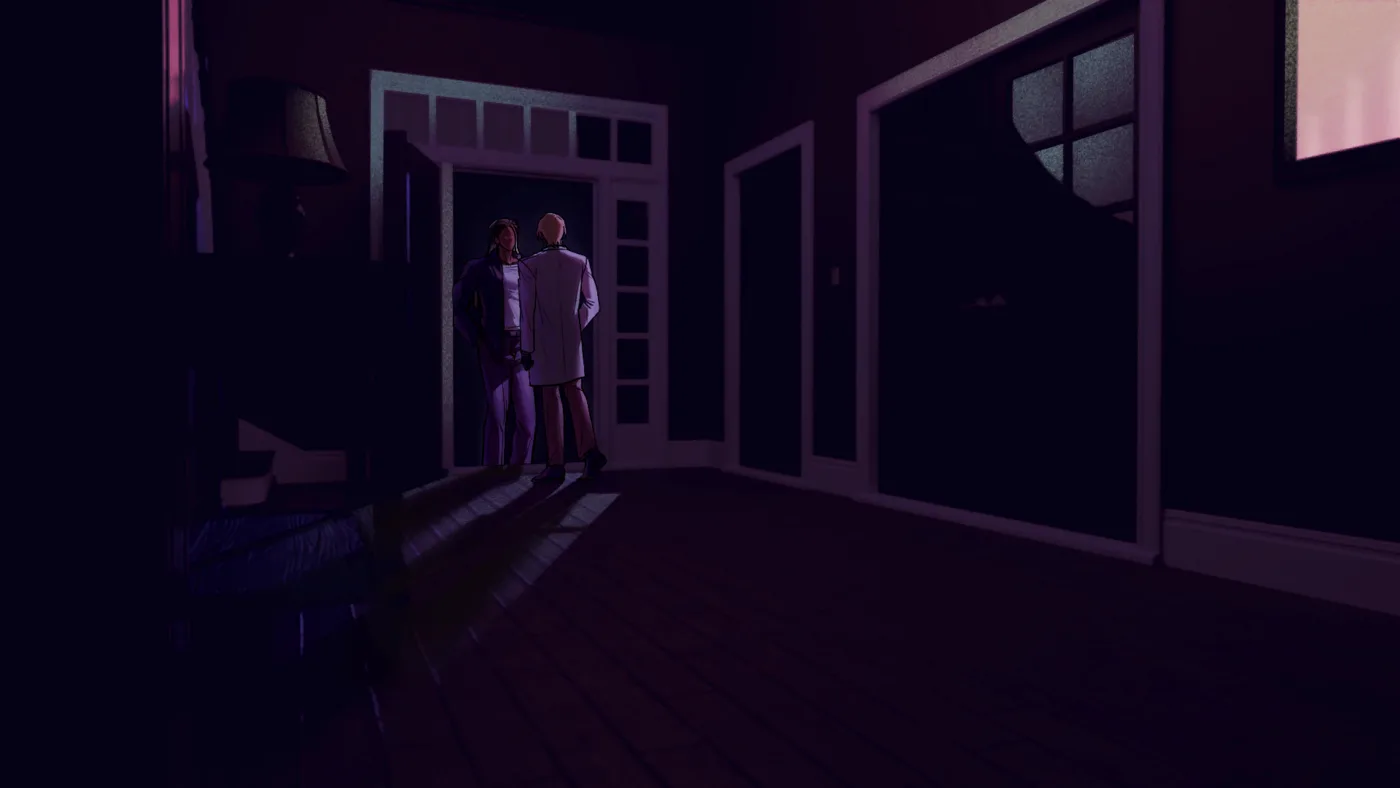
The escape sequence, check by check
The escape is the only place where several flags are read in a single chain, and the order matters, because the chain falls through check by check and the first match wins. If you have seen the route described as a list of conditions, this is the list in the order the script actually applies it. Get the order right and two of the four endings stop being mysterious.
| Order | Check | Result |
|---|---|---|
| 1 | clickedLivingDoor | Routes to #Exit. |
| 2 | hasKey | Routes to #KeyDoor. |
| 3 | Otherwise | Routes to #ClickLoop. |
| 4 | secretRoomVisited | Routes to #KeyDoorOpen. |
| 5 | Next step | Routes to StoryGame/PhoneOutside1. |
| 6 | toldAddress | Set routes to StoryGame/Outside2. Not set routes to StoryGame/Outside1. |
All six checks run inside StoryGame/LockingDoor2. After the sixth, StoryGame/Outside2 splits once more on Ian's affection: at ianRelation 40 or higher it routes to StoryGame/IanRoute2, which leads to StoryGame/Police2 and Ending 04. Below 40 it routes to StoryGame/Police1 and Ending 03. If you never set toldAddress, you never reach that split at all — you are on StoryGame/Outside1 instead, and Ian walks you back to the house.
Read as a plan, the chain says this. The living room door is checked first, so trying it puts you down the #Exit branch before the key is ever consulted. Holding the key routes to the key door. With neither, you go round the click loop, and the chain only moves on once you have actually been inside the secret room behind the locked door. After that comes the phone outside, and only then does the address question get asked. In other words, the phone screen is the last stage of the escape, not the first, and by the time you are dialling, your route is already half decided.
Two practical consequences. First, the secret room is a hard prerequisite: secretRoomVisited is what moves the chain off the click loop, so a run that never finds the secret room never reaches the phone. Second, the address has to be in your head, in your own words, at the right moment, because toldAddress is read at step six and nowhere else. There is no way to set it late.
The five minigames to tick off
Five activities break up the story, and they are where first runs actually end. Two of them write flags that change which ending you can reach, so they belong on a completion checklist even if you are only playing for the story. The controls matter more here than anywhere else, so they are worth a sentence each: left click or Enter advances dialogue, the mouse points, clicks and drags during the activities, Space hides or shows the dialogue box, the arrow keys plus the spacebar answer quick-time events, and clicking the bell at the top opens Save, Load and Settings.
| Activity | When it happens | What it records | What it costs you if you skip it |
|---|---|---|---|
| Doll disassembly | Day 1 and the following nights | Nothing the route reads directly. The naming choice is recorded, and the scalpel is an object you pick up. | The bear on the table is the first one, and it is the only place you handle this story's evidence with your hands. |
| The pill | Midnight 1 and Midnight 2 | tookPill at Midnight 1, and spatPill from StoryGame/Day2Evening. |
This is the hinge of the whole game. A brief press only reads the option; a held press confirms it. |
| The basement | After the locked door is opened | The key branch. hasKey is what makes the locked door open at all. |
It sits inside the escape chain, so failing it means the chain never advances past the click loop. |
| The phone | StoryGame/PhoneOutside1, after the escape |
phoneTried, phoneCorrect, phoneLeave and oliverCallDropped. |
Without the right two digits you never reach Oliver Freeman, and a wrong number only gets you No signal. |
| Quick-time events | The frantic moments, including the attack sequence | The attack branch itself, via useKnife in StoryGame/Day3_Act2. |
A missed input can drop you into StoryGame/GameOver1, StoryGame/GameOver2 or StoryGame/GameOver3 instead of the ending you wanted. |
The quick-time events are the one entry on this list that can lose a run outright rather than quietly change it. The input changes completely between activities: a mouse drag in the doll job, a held press at the pill, arrow keys plus the spacebar in a quick-time event. The game never asks for the same input twice in a row, so repeating the key you just pressed is the reliable way to fail. The three game over scenes are where that failure is expressed, and StoryGame/GameOver3 even has a bodytype branch for the female body type, so the outcome is not identical every time.

The four dolls Adrian brings or names
On Day 1 Adrian brings home a green dinosaur and asks you to name it. There are exactly four options and the game records whichever you pick: O'Green, Jeff the dark-lord of the darkness realm, Diny the bed-watcher, and Bob. It sounds like throwaway flavour and it is not quite. The naming happens on the same evening as the doll job, which is the point the game is making: you are already handling one child's toy before you have been told anything about where the others came from.
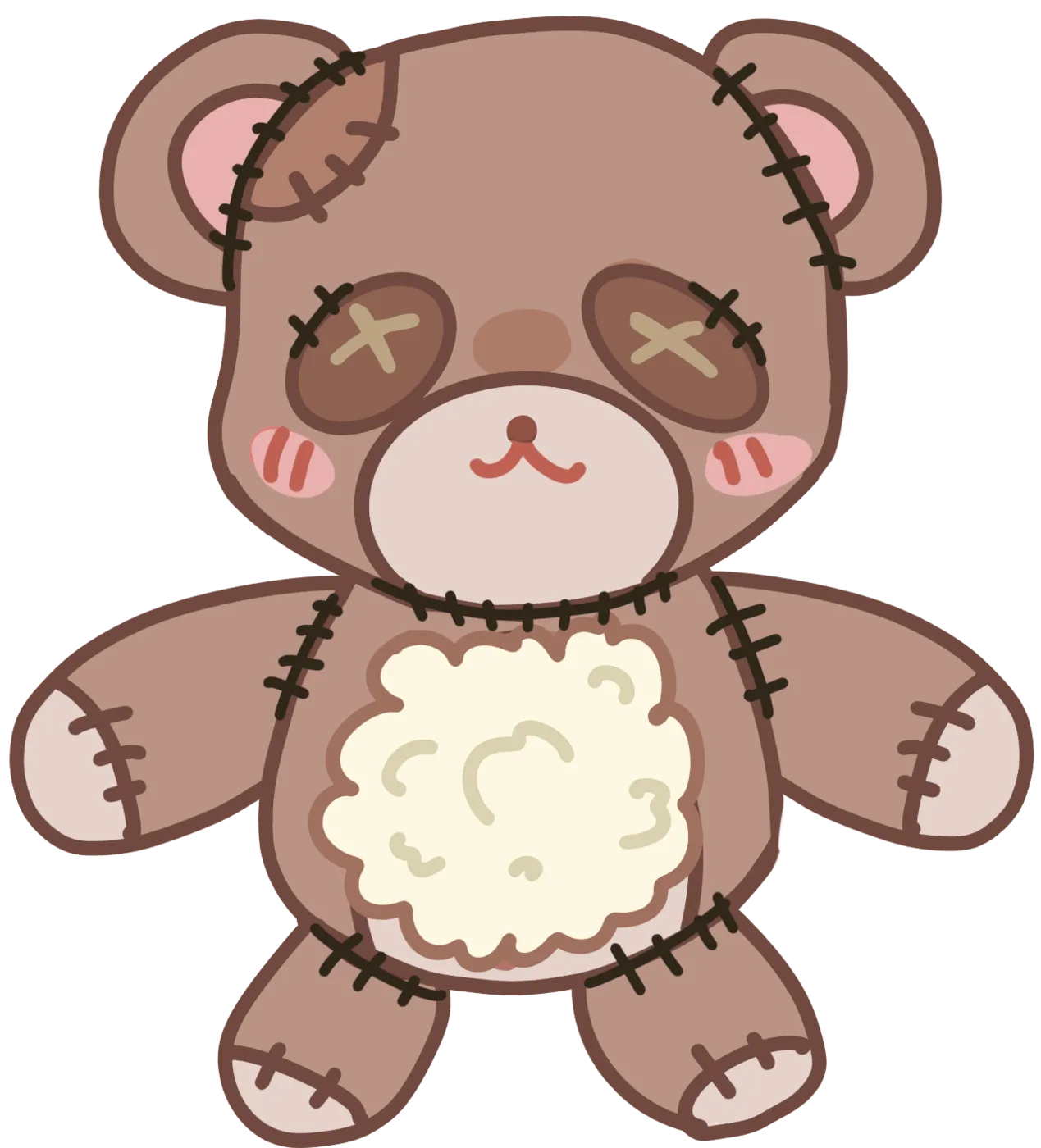
Separately, Madison named the teddy bear Adrian made for her Macaroni, and she carries it everywhere. Madison is an orphan Adrian talks about, abandoned at an orphanage at two and struggling to talk with the other children, and the bear is the thread the doll job hangs from. When you pull that bear apart on Day 1, you are handling something that belongs to a child the story has not properly introduced yet, and the game does not let you forget it.
Mechanically the activity is simple: point at a piece, hold the mouse down, drag it over the right bin and release. There is no timer and no fail state, because this is a chore rather than a challenge, and the game wants you to feel how tedious and how intimate the chore is. Two details in the frames below are worth a second look. The bear's belly is already cut open in the assembled shot, which means the disassembly is not the first time anything has been opened. And there is something flat and pink sewn inside the chest cavity, hidden in the one place you would only find by taking the whole thing apart.

The other branch points
Some branches announce themselves with a choice on screen. Others are a label in a script that fires while you are reading, and you only find out about them afterwards. These are the ones worth ticking off before you start a completion run, because several of them are decided in a scene that looks like ordinary dialogue.
StoryGame/Day2Evening has three labels: #Trusting, #Take and #Spit. It routes to #Trusting first when wentOutside is false, so the scene you see depends on whether you have already left the house once. StoryGame/Midnight1 has #OpenEyes, #Take, #Refuse and #Vanish, and taking the pill there sets tookPill. StoryGame/Explore has a #Parcel branch that sets sawParcel, a #Photo branch, and an #ExploreLoop that sends you back round. StoryGame/LoverTime2 has a #MakeupEnd branch and a #Meds branch.
StoryGame/Day3_Act2 splits on useKnife: with the flag set it routes to StoryGame/Attack1, and without it to StoryGame/ICanFixHim. StoryGame/Attack1 carries its own #A1_after label and leads into StoryGame/Attack2, which leads to StoryGame/FinishHim. StoryGame/Searching blocks itself through #NoSearch when adrianRelation is above minus 3. StoryGame/IanRoute1 has #FreeTime and #FlowerShop branches, and both of those sit downstream of the greater-than-14 check, so a run that never opens the route never sees them.
Two smaller things. The game over variants are StoryGame/GameOver1, StoryGame/GameOver2 and StoryGame/GameOver3, and the third has a bodytype branch for the female body type, so not every failure looks the same. And the endings themselves run through StoryGame/ED1 to StoryGame/ED4 before StoryGame/EndCredit, with StoryGame/NewScript in the set for post-ending material. Once g_clearedOnce is set, the game knows you have finished, which is what makes chase runs and flag hunting behave differently on later attempts.

Frequently asked questions
How many endings does Helping Your Boyfriend have?
Four. ENDING 01 is My boyfriend is the best, ENDING 02 is The cage, ENDING 03 is The Empty Cage and ENDING 04 is Moving Forward. They split along how much you trust Adrian, how much you trust Ian, and whether you ever get out of the house. The game does not label any of them good or bad, so neither should your checklist.
What separates Ending 03 from Ending 04?
One number, and it is Ian's affection. Both endings come out of the escape route, and Outside2 splits on ianRelation: a value of 40 or higher opens IanRoute2 and leads to Police2 and Ending 04, Moving Forward. Anything below 40 falls through to Police1 and Ending 03, The Empty Cage. The comparison is greater-than-or-equal, so exactly 40 is enough to reach Ending 04.
How do I open Ian's route?
Ian's affection has to be greater than 14, not 14 or more. The script checks IanRoute1 with a strict greater-than comparison, so a value of exactly 14 does not open the route and you need 15 or higher. The route itself splits into two branches, one where you have free time and one set in the flower shop.
Which flag is the most important one in the game?
toldAddress, the flag set when you give Ian the address of the safe place, 742 Silverwood Creek Lane, Silverwood Springs, CA 95401. It is written on the parcel Adrian brings home, the escape sequence checks it, and without it the story routes to Ending 02, The cage, where Ian walks you back inside.
What does Adrian's approval actually gate?
Two things. In Searching, an approval value greater than minus 3 routes to NoSearch and blocks the searching branch, so low approval closes that door. And in Day2Evening, taking Adrian's medication adds 2 to the approval and routes to Day3_ED1 and Ending 01, while pretending to swallow the pill and spitting it out adds 1 and sends you to Midnight2 instead.
Which clues do I have to read before the second half of the game?
Four of them. The address on the parcel Adrian brings home, the two digits of a phone number written in ink on your arm that fade over time, the family photograph in Adrian's room where the boy in the middle is Adrian but with black hair, and the newspaper headline in the living room about a recent murder case that you are interrupted before you finish reading.
How do I dial the phone number correctly?
Two digits of the number are written in ink on your arm and they fade, so write them down the moment you see them. The phone screen branches on four flags: phoneTried, phoneCorrect, phoneLeave and oliverCallDropped. The number you want is Oliver Freeman's, and dialling the wrong one gets you No signal with no hint about which digit was wrong.
What does the clearing flag do?
g_clearedOnce is set after any ending is reached, and it marks that you have cleared the game once. It is the one flag on this list you cannot set by choosing anything, because finishing a run is the only way to set it. Tick it after your first ending and leave it alone afterwards.
Do the minigames affect the endings?
Two of them do. The pill minigame sets tookPill and spatPill, and spitting the pill out in Day2Evening is what takes you off Adrian's route. The phone minigame sets phoneTried, phoneCorrect, phoneLeave and oliverCallDropped. The doll, the basement and the quick-time events still matter, because a missed quick-time input can drop you into one of the three game over scenes instead of the ending you wanted.
Is one of the four endings the good one?
No. The game does not classify them, and the four are not variants of one ideal outcome. My boyfriend is the best keeps you inside with Adrian and ends on a newspaper profile of his award. The cage sends you back inside after you try to leave. The Empty Cage and Moving Forward share the same three-months-later frame and differ in what happened to Ian. Choose the one whose story you want to sit with.