The escape route is a chain of five things
Almost every player stuck on the escape endings is missing one link in a five-link chain, not one big revelation. One scene, LockingDoor2, checks flags in order, and if one is missing the chain folds back and you finish the story inside the house, with Adrian.
That is why the escape can feel like it almost worked. You get the key, through the door, take the phone, make the call, walk out into the rain, and still get the wrong ending. Nothing was flagged as wrong. One flag was never asked for.
The one thing to remember
The escape door does not open on the key. The key only gets you into the room. The door opens on toldAddress, set when you give Ian the address. Everything else is preparation.
-
Find the key —
hasKeyPicking up the key sets
hasKey, the only flag that lets you through the door: inLockingDoor2it routes you to#KeyDoor, while a missing key sends you around#ClickLoop. The basement screen also has a#KeyStubbranch that only opens whenhasKeyis set. -
Open the locked room —
secretRoomVisitedWith the key you open the door and step inside, which sets
secretRoomVisited. That flag routes you to#KeyDoorOpen: the door is open, the sequence continues, and the phone sequence comes next. -
Take the phone from the desk
The phone on the desk in the secret room is how you reach Oliver Freeman, and it carries the whole family of phone flags:
phoneTried,phoneCorrect,phoneLeaveandoliverCallDropped. -
Dial Oliver correctly —
phoneCorrectThe ink on your arm had long faded, but you still remembered two of the digits. Two digits of a number were written in ink on your arm, and they are enough to dial Oliver Freeman if the rest is right. A wrong number gets you no signal;
phoneCorrectis the only phone flag that keeps a real voice on the line. -
Give Ian the address —
toldAddressThe step most players miss, and the one the ending turns on. Telling Ian the address sets
toldAddress, which decides whether the escape ends atStoryGame/Outside2orStoryGame/Outside1. Get it wrong and the other four links buy nothing: you get Ending 02, The cage.
Notice what is not on that list: Adrian's approval. His meter has one threshold of its own, in a different scene. In StoryGame/Searching, adrianRelation > -3 routes to #NoSearch and closes the searching branch. Adrian's mood decides how much of the house you may search, not whether the escape door opens.
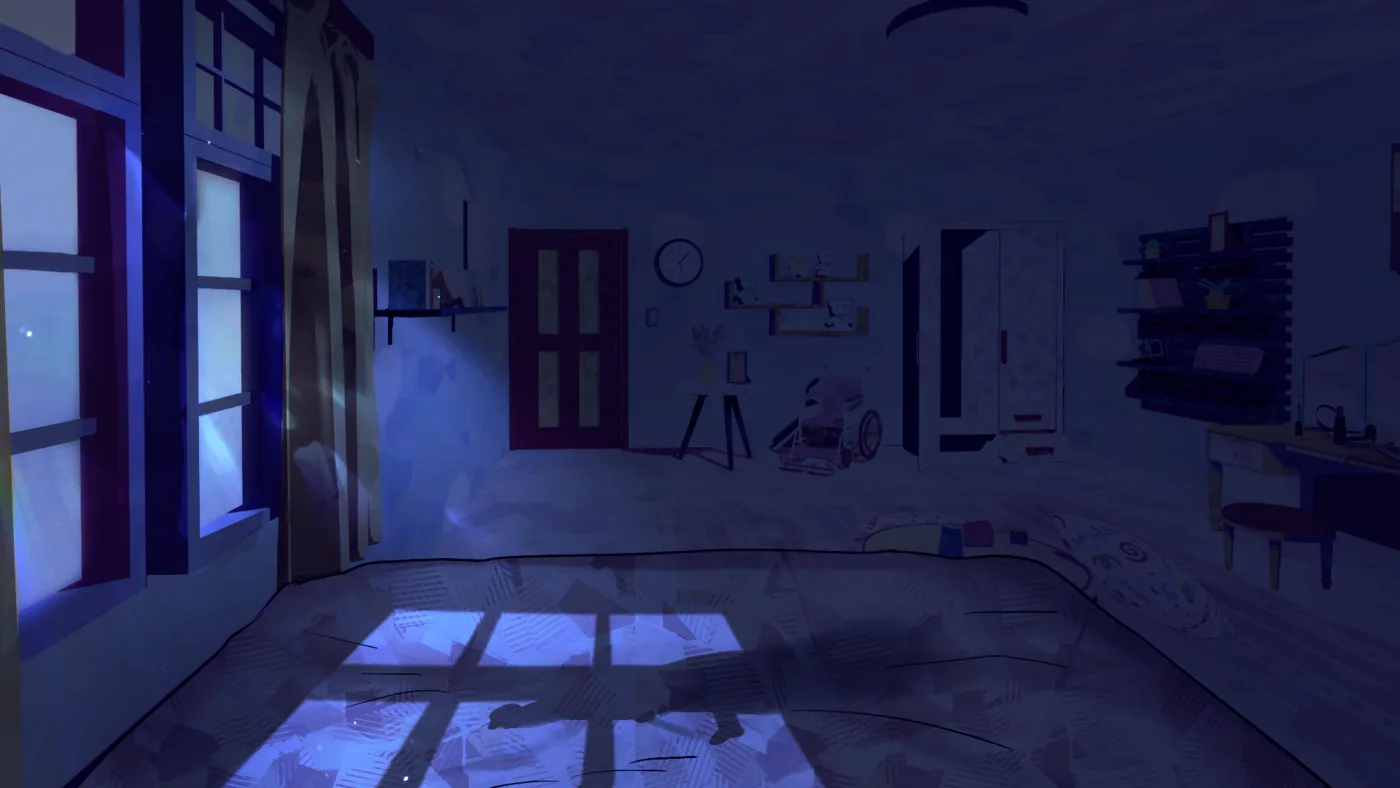
The locked room and the exact order of checks
All of this happens in one scene, which evaluates its conditions in a fixed order. The order matters, because the checks are nested: each branch either ends the scene or hands it to the next check, and that decides which flags are even consulted.
| Order | Condition | Goes to | What it means |
|---|---|---|---|
| First | clickedLivingDoor | #Exit | Tried the living room door on the run. |
| Second | hasKey | #KeyDoor | You reach the locked door. |
| Second, otherwise | neither of the above | #ClickLoop | No key, no door. |
| Third | secretRoomVisited | #KeyDoorOpen | Already inside; the door is open. |
| Fourth | either branch of the room check | StoryGame/PhoneOutside1 | Both sides lead into the phone sequence. |
| Fifth | toldAddress | StoryGame/Outside2 | You get the full escape route. |
| Fifth, otherwise | no toldAddress | StoryGame/Outside1 | The story commits to Ending 02. |
Three things fall out of that table.
The living room door is checked first, and it is a dead end. If clickedLivingDoor is set, LockingDoor2 jumps to #Exit before it looks at your key. Trying the wrong door first is not a mistake the story forgives. It short-circuits the sequence.
The key is checked before the room. There is no path to #KeyDoorOpen that does not first pass through hasKey. The key is a permission token, not just a key. And the searching scene can be shut off: when adrianRelation is above -3, StoryGame/Searching routes to #NoSearch and that branch is closed. A cold Adrian can lock you out of the information you need.
The address is checked last, at the exit. That is why it feels like an afterthought when you first see the parcel, and why it is so easy to walk out without it. The game does not ask for the number before the door. It asks for it afterwards, standing in the rain, when handing it over costs you something. There is no error message, only a quieter ending.
There is no try-again here
Once LockingDoor2 routes into StoryGame/Outside1, the story is committed to Ending 02. Nothing lets you walk back in, so the fix is a save reload or a fresh run with toldAddress set in advance.
What is actually inside the secret room
The secret room is the most honest piece of art in the game. The door is in Adrian's own bedroom, and when it opens the pastel palette drops away. The room is bathed in crimson splatters. Through the sunlight coming through the door you catch a glimpse of a phone on a desk. And a foul stench of decay hits you as it opens, the first thing in this game that tells you, without a line of dialogue, that people were hurt here.
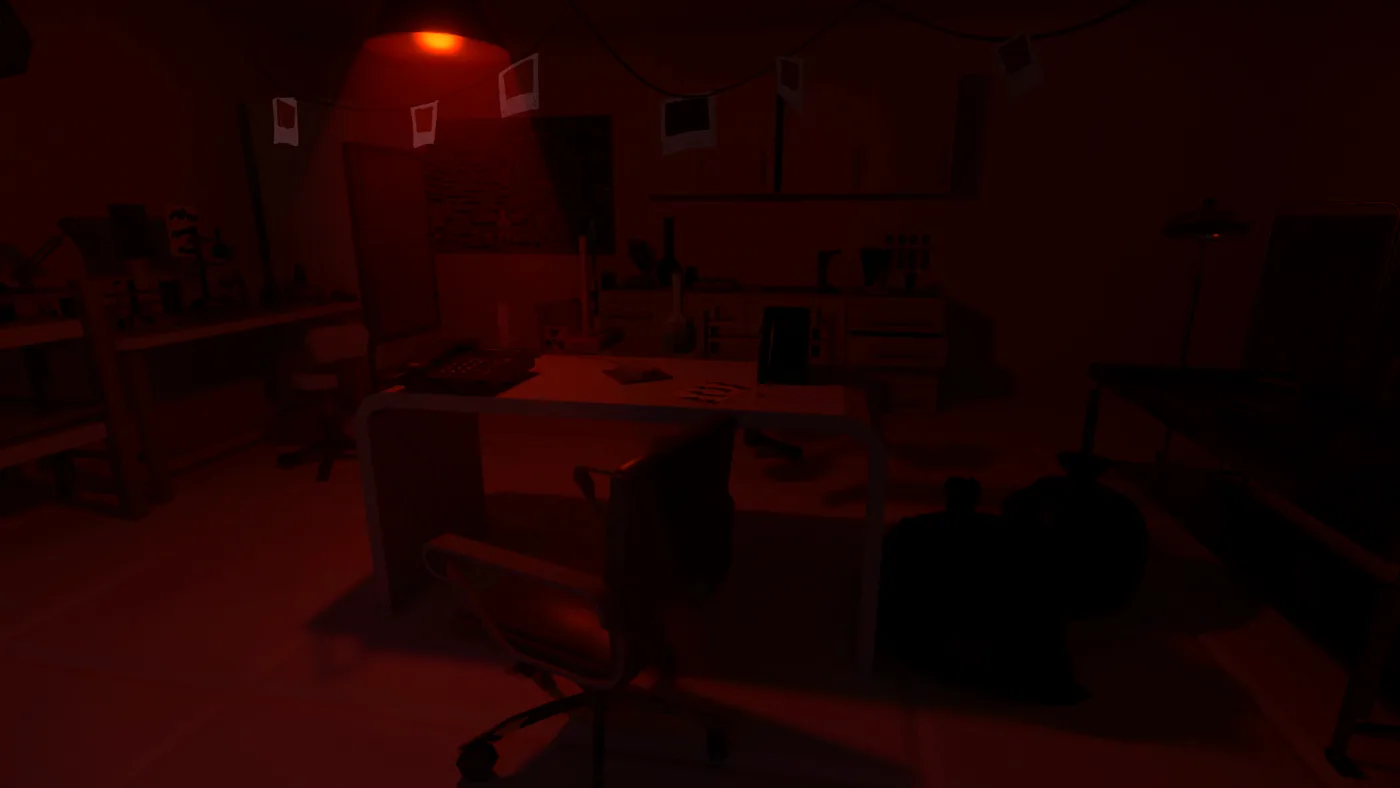
Read the room as a workspace and it tells you about the man. A desk with a typewriter, shelves of equipment, papers pinned on the wall. Nothing improvised, nothing theatrical, and the horror is not the red lamp, it is the tidiness. The doll you were paid to take apart belongs to the same category of object as whatever is pinned to that wall, and the photographs here belong to what Adrian does after dark.
Mechanically the room is a reward, not a maze. Nothing in it needs solving. What you take out is the phone on the desk and a clear idea of what you live under the same roof as. Adrian, head of Diagnostic Pathology at Valleybrook Hospital and still a bachelor, has a public life a few rooms away from a private one lit by one red lamp, and the game never asks you to reconcile the two.

That is where the key keeps paying off: the #KeyStub branch only opens when hasKey is set. Hold the key and it is waiting for you; without it you are clicking around a dark room for nothing.
The address: the one detail that opens the door
Here is the number in full: 742 Silverwood Creek Lane, Silverwood Springs, CA 95401. It is the single most important detail in the game, and it takes four seconds to read on a cardboard box you probably walked past twice.
It comes from the parcel Adrian brings home. The exploring sequence has a #Parcel branch, and taking the parcel sets sawParcel. On the parcel, the sender and receiver addresses are clearly on it, and the receiver address is the house's address. That is the number you hand to Ian, and the script records it as toldAddress, giving Ian the address of the safe place.
What makes this so effective is that the address is not a stranger's safe house. It is the address of the house you are trying to leave, written on a package Adrian carried home with his own hands. You hand Ian the number of the place you are escaping from, and the game treats that as correct. Whether that is a hole in the fiction or a joke at your expense is a question the game never answers.
Memorise this before the door
742 Silverwood Creek Lane, Silverwood Springs, CA 95401. You do not type it into a menu. You say it out loud to Ian, at the end, when you are already outside and frightened. Decide now that you know it, because the scene gives you no second chance to look at the box.
One more reason to grab the parcel early: the explore sequence also has a #Photo branch and an #ExploreLoop, and it is natural to spend all your attention on the family photograph with four smiling members and the boy in the middle whose hair is black. The photograph is worth reading, but the parcel carries the number.
The phone, the two digits and Oliver Freeman
Where the key is about permission and the address about commitment, the phone is about knowledge you already had and almost lost. Two digits of a number were written in ink on your arm, and the ink had long faded by the time you needed it, but you still remembered two of them. The game treats that fragment as the basis of the escape: a memory, and Oliver Freeman at the other end.
The phone sequence branches on four flags, each a different way to fail.
phoneTried— you tried to dial a number on the phone.phoneCorrect— you dialled the correct number. This is the one you want.phoneLeave— you left the phone without calling.oliverCallDropped— you dropped Oliver's call.
Dialling the wrong thing gets you no signal, a hard dead end, so do not spend the attempt on a guess. The number is Oliver Freeman's, and the game hands you two of its digits for free.
Get it right and the person on the other end introduces himself. He tells you it has been almost a month since you disappeared, and the month matters: it tells you how long you have been inside that house and how long somebody outside it was already looking. Oliver had been parked in the alley by Adrian's house, patrolling day and night because he suspected Adrian. That is why you were ever rescued at all.
On the line
Hello, Oliver Freeman speaking, may I know who this is? And then the thing you have waited three in-game days to hear: it has been almost a month since you disappeared. Oliver is an officer of the law, and later, in the rain, he stops Ian's syringe by climbing over the fence just in time.
The escape needs both of them. Ian opens the door from the inside. He knows the house, he tells you the front door is not an option, and he ends up between you and Adrian. Oliver answers from the outside. He is a voice on a phone in a room full of red, and later the reason you are not lying in the rain. Ian without Oliver leaves you on the doorstep; Oliver without Ian never gets to pick up.
The parcel changes which call you get
Here is a branch difference that catches people out, because it is invisible from the outside. The explore sequence has a #Parcel branch, and taking the parcel sets sawParcel. Find it and your call goes to Oliver3; miss it and it goes to Oliver2.
Those are two different scenes, so the wording differs between runs. Two players comparing notes will notice the phone conversation did not read the same way, and one of them never found the parcel.
But the branch difference is not why the parcel matters. The parcel matters because it is where the address is written. sawParcel is a findable object in the script, but its real value is that it puts the number for toldAddress into your hands before the door. Either way you still need phoneCorrect to reach Oliver and toldAddress to leave for good.
The order that survives every branch
Parcel first, because it carries the address. Then the key, then the locked room, then the phone, then the address to Ian. Keep that sequence and let the phone call happen whenever it happens.
Reaching the phone without the secret room
Here is the misconception that wastes the most time. A lot of players believe the secret room is the gate to the phone, that you must open the locked room before you can call. The check order shows otherwise: both branches of the room check in LockingDoor2 end at the same place, StoryGame/PhoneOutside1. Whether you have been inside the secret room or not, you get the phone screen, and the phone minigame plays there.
So what does the secret room buy you? The phone in your hand, the photographs, and the knowledge of what Adrian does after dark. Not access to the phone screen, and not the ending. The flag that decides your ending is toldAddress, tested at the very end of the sequence, after the door and after you are outside.
StoryGame/Outside1 — the short escape
- You have no
toldAddress. - You meet Ian in the rain.
- Ian tells you there is nowhere else that is safe except that house, exactly as Adrian told you, and calls you a fool.
- You go back inside with him.
- Ending 02, The cage.
StoryGame/Outside2 — the real escape
- You have
toldAddress. - You go further, and the story splits on Ian's affection.
ianRelation >= 40routes toStoryGame/IanRoute2, which leads toPolice2and Ending 04.- Otherwise it routes to
StoryGame/Police1and Ending 03.
Read those two columns side by side and the route is clear. The secret room and the phone are about information: they give you the means to reach Oliver and the reason to want to. The address is commitment, and it is the single act that makes the escape irreversible.
After you are out: Ian, the police, the endings
Getting out of the house is not an ending. The game treats outside as a new phase, branching on Ian's affection. StoryGame/Outside2 splits on ianRelation: at ianRelation >= 40 it routes to StoryGame/IanRoute2, the second half of Ian's route, which leads into Police2 and Ending 04. Below 40 it routes to StoryGame/Police1 and Ending 03.
The Empty Cage
Three months later you are in hospital. Adrian is revealed as a serial killer who kidnaps people and has them perform his dissections. He is missing; the police raided the house and found nothing but bloodstains. Ian is also missing. Oliver visits you constantly, because he had been parked in the alley by Adrian's house, patrolling day and night because he suspected Adrian. When you glance out the window you catch a figure in the crowd. You say nothing.
It is the safest ending and the loneliest. You are free of Adrian and you have lost Ian too.
Moving Forward
Same three-months-later frame as Ending 03, with one difference: Ian was sent to a psychiatric hospital nearby, and doctors sometimes let him use a mobile phone. You call each other from time to time and he tells you all sorts of stories that you listen to. He is an even better speaker on the phone than face to face. Maybe someday you will see each other again, maybe that day is the day he opens his flower shop. Adrian is still missing.
It is the only ending where somebody is still talking to you.
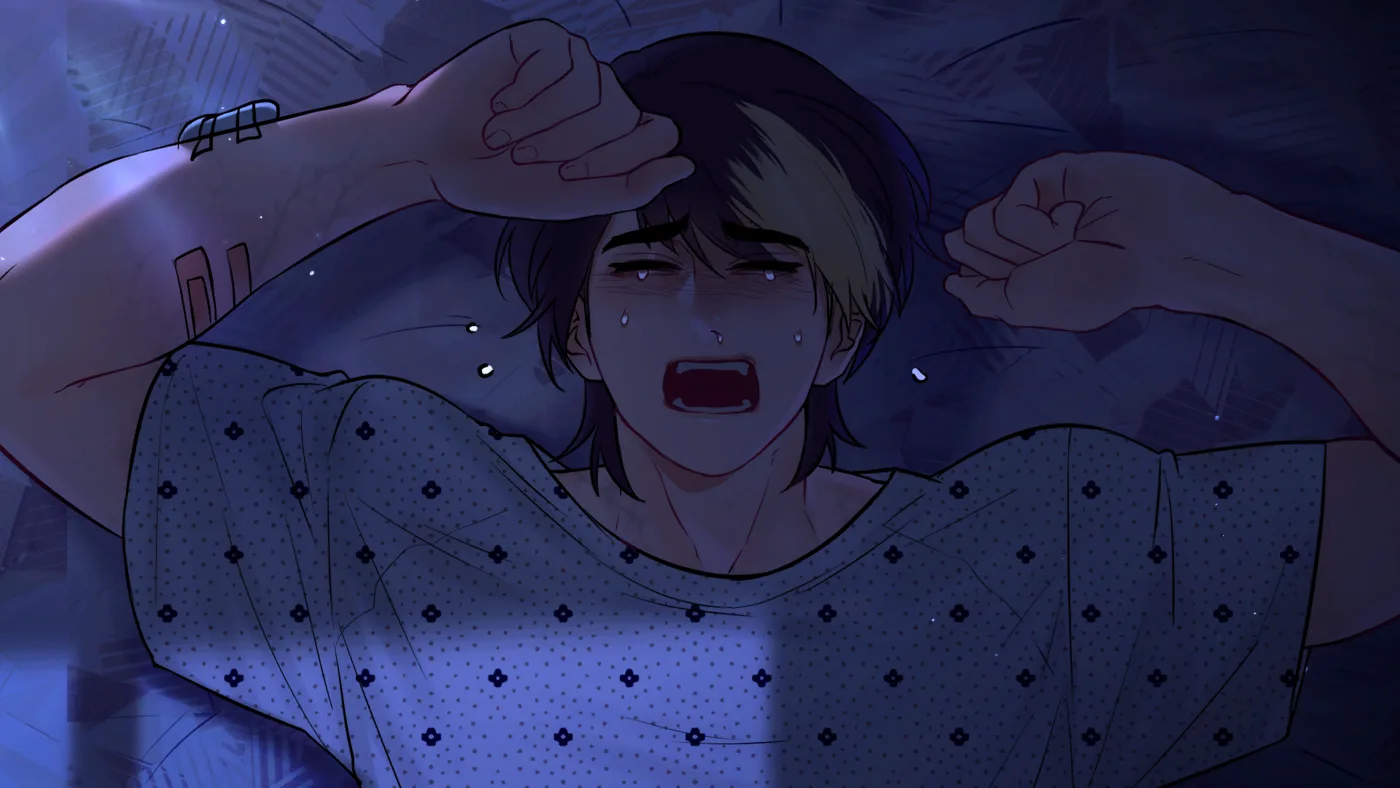

Both endings open in the same place: a hospital room, three months later. The only difference is Ian, and below 40 you have simply traded one locked room for a quieter cage.
So the planning question is not about escaping, but about trust. ianRelation > 14 unlocks IanRoute1 with its #FreeTime and #FlowerShop branches, and ianRelation >= 40 is the line between Ending 03 and Ending 04. If you want Ending 04, the work happens long before the door opens.
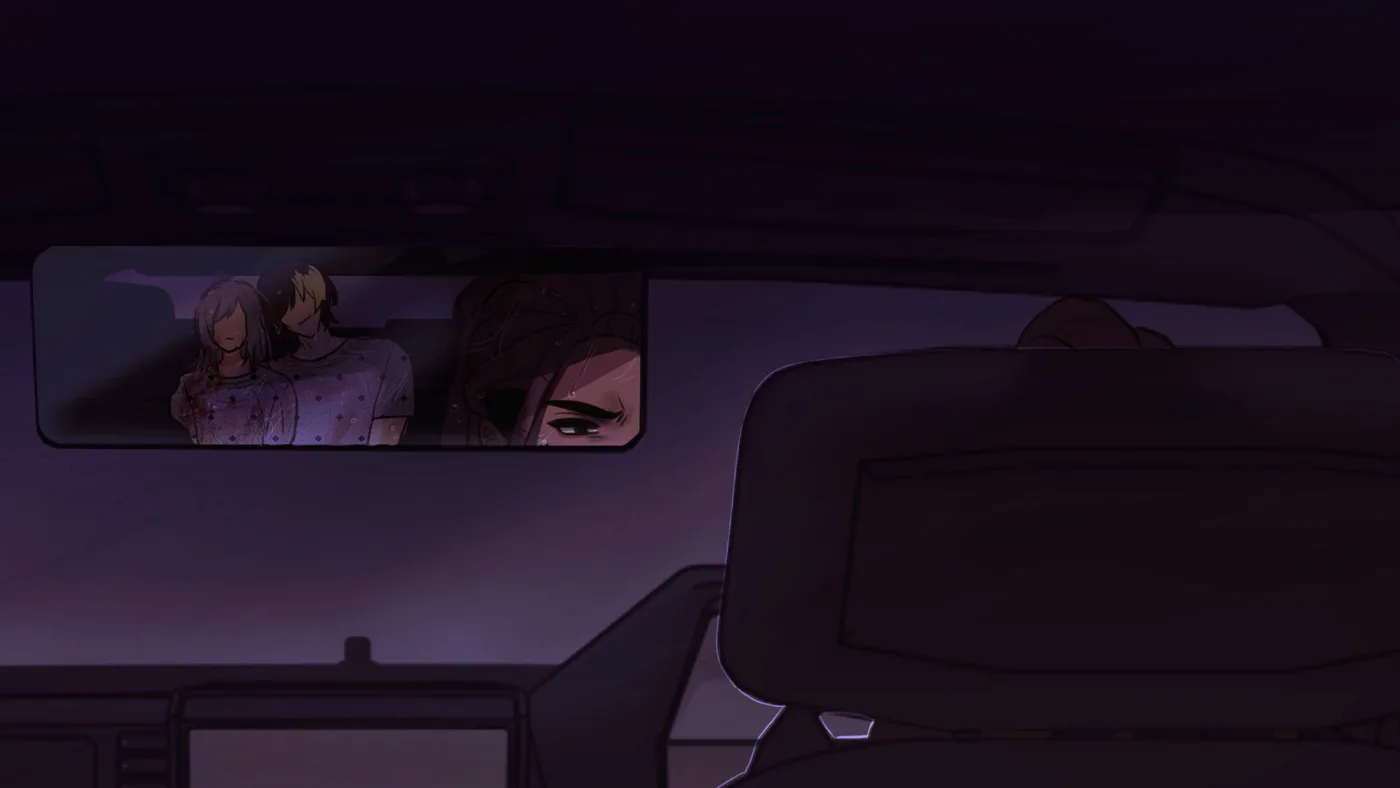
For contrast, there is the route that never leaves the house. If you never go outside and you accept the medication Adrian hands you, Day2Evening routes into Day3_ED1 and you get Ending 01, My boyfriend is the best: a newspaper reports that the Eastern Committee of Medical Associations publicly praised Dr. Adrian Winchester and gave him the Outstanding Physician for Innovation and Medical Diagnostics of the Year award, and notes that the 30-year-old physician is still a bachelor.
The scalpel and the knife, the fork before the escape
There is one more fork, and it happens before the escape. Day3_Act2 has two branches, and the condition is useKnife, the flag that records that you used the knife.
- When
useKnifeis true,Day3_Act2routes toStoryGame/Attack1. That is the attack sequence: it has an#A1_afterlabel and leads intoAttack2, which leads toFinishHim. - When
useKnifeis false,Day3_Act2routes toStoryGame/ICanFixHim.
Separately, hasScalpel records that you picked up the scalpel. The two flags are genuinely separate: picking something up and using it are different acts. You can carry a scalpel and never use a knife, and you can use the knife without the scalpel ever being in your hands. The flags tell two different stories about who you were in that confrontation.
The escape itself is reached from Attack4, which leads into LockingDoor2. Whichever way you come out of the confrontation, the door and the checks are the same. The fork changes the emotional cost of reaching the door, not the conditions of it.
Do not mistake the fork for the route
It is natural to assume the aggressive branch leads to the better ending and the passive branch is the safe one. But neither branch sets anything that LockingDoor2 reads. You still need the key, the room, the phone and the address. Choosing a branch changes what you live with afterwards, not whether you get out.
One more flag belongs on this list, and it belongs here only so you can ignore it properly: g_clearedOnce is set after any ending is reached and marks that you have cleared the game once. It is a completion marker. Nothing in the escape chain reads it.
The escape checklist
Keep this list open next to the game. Every line is a flag or a fact you can verify in the script, and nothing here is something the game will prompt you for.
- The key —
hasKeyis set. Without it you loop through#ClickLoopinstead of#KeyDoor, and the basement#KeyStubbranch stays shut. - The locked room —
secretRoomVisitedis set. You have been inside the room, and the phone on the desk is in your hands. - The parcel —
sawParcelis set. You found the parcel Adrian brought home, so you have the address, and your call goes toOliver3rather thanOliver2. - The address — 742 Silverwood Creek Lane, Silverwood Springs, CA 95401. You know it before the door, because there is no chance to look at the box once you are outside.
- The phone —
phoneCorrectis set. You dialled the right number and Oliver Freeman picked up.phoneTried,phoneLeaveandoliverCallDroppedare all wrong answers. - The address given —
toldAddressis set. This is the one that decides the ending:StoryGame/Outside2instead ofStoryGame/Outside1. - Ian's affection —
ianRelation >= 40if you want Ending 04. Below 40 you get Ending 03, and Ian vanishes with no known whereabouts. - The knife —
useKnifeis your call, not a requirement. It decidesAttack1againstICanFixHimand nothing else in the chain.
Frequently asked questions
What is the address I have to give Ian?
742 Silverwood Creek Lane, Silverwood Springs, CA 95401. It is written on the parcel Adrian brings home, with the sender and receiver addresses on it, and the receiver address is the address of the house. Telling Ian that number sets toldAddress.
Which flag actually opens the escape door?
toldAddress. The key only gets you into the secret room and the phone only gets you a voice on the line. LockingDoor2 tests the address last: toldAddress routes you to StoryGame/Outside2, and without it you get StoryGame/Outside1 and Ending 02.
Why do I keep ending up in Ending 02, The cage?
Because toldAddress was never set. Ending 02 is reached from StoryGame/Outside1, which LockingDoor2 routes into when toldAddress is missing. Ian tells you there is nowhere else that is safe except that house, exactly as Adrian told you, calls you a fool, and you go back inside.
What is the difference between Ending 03 and Ending 04?
It is entirely Ian's affection. Both endings open three months later in a hospital room, with Adrian missing and a figure in the crowd you say nothing about. Ending 03, The Empty Cage, comes through StoryGame/Police1 when ianRelation is below 40, and Ian is missing too. Ending 04, Moving Forward, comes through StoryGame/IanRoute2 at 40 or higher, with Ian in a psychiatric hospital nearby.
Can I reach the phone without going into the secret room?
Yes. In LockingDoor2 both branches of the room check lead to StoryGame/PhoneOutside1, so the phone screen plays whether or not secretRoomVisited is set. The room gives you the phone and the knowledge of what Adrian does after dark. The flag that changes your ending is toldAddress.
Does finding the parcel change the call?
It changes which version you get. The Explore sequence has a Parcel branch that sets sawParcel: find the parcel and your call goes to Oliver3, miss it and it goes to Oliver2. The two are different scenes, so the wording differs. The parcel matters because it is where the address is written.
What happens if I dial the wrong number on the phone?
You get no signal. The phone screen branches on phoneTried for trying a number, phoneCorrect for dialling the right one, phoneLeave for leaving without calling, and oliverCallDropped for dropping the call. Only phoneCorrect keeps Oliver on the line.
Do I need the scalpel or the knife to escape?
No. hasScalpel records that you picked up the scalpel and useKnife records that you used the knife; they are separate flags. useKnife decides one fork: Day3_Act2 routes to Attack1 when it is true and ICanFixHim when it is false. Neither branch adds anything LockingDoor2 reads.
Where does the key come from?
The key is a pickup that sets hasKey, the only thing that gets you through the locked door. In LockingDoor2 it routes you to the KeyDoor branch, and without it you loop back through ClickLoop. The basement screen has a KeyStub branch that only opens when hasKey is set.
Where to go next
Read the endings guide next for the two routes you have not seen and the conditions that separate all four, and the choices guide if you are still deciding how to treat Ian.