
Quick reference: the three days at a glance
This is a scene-by-scene walkthrough of Helping Your Boyfriend, from the setup screen to the credits. Read it as a map before you start, or play first if you would rather keep the surprise.
Two facts shape everything below. The game never once tells you that it is a horror game, and none of the four endings is labelled good or bad. The split is not moral, it is mechanical: how much you trust Adrian, how much you trust Ian, and whether you ever get out of the house.
Before you start
The game carries a content warning for jumpscares, loud noises, flashing and disturbing images, blood and cartoon gore, violence, drug use, unhealthy and obsessive behaviour, toxic relationships and crude language. The creators also state that all characters and events are fictional and that they do not condone anything in the game.
| Beat | Scene label | What it does |
|---|---|---|
| Setup | Setup screen | You pick a first name, a last name, pronouns and a body type |
| Day 1 | Day1 | 21 June, 08:12 PM. Adrian comes home, the teratoma story, the doll job, the dinosaur |
| First midnight | Midnight1 | A stranger, a hand over your mouth, and a pill |
| Day 2 | Day2Awake | The routine continues |
| Exploring | Explore | The parcel branch and the photo branch |
| Before bed | Day2Evening | Adrian hands over the medication |
| Day 3 | Day3_Act2 | The act two decision point, split on useKnife |
| The escape | LockingDoor2 | The door, the key, the phone and the address |
Setup: name, pronouns and body type
Before the first line of dialogue, the game asks you four things: a first name, a last name, pronouns (neutral, feminine or masculine) and a body type. Then it threads those answers through every line that follows. Your name is spoken by Adrian, by Ian and by whoever else is in the room with you, and you will hear it in rooms where hearing your own name is the last thing you want.
The pronouns change the grammar of the prose. The body type is genuinely stored and genuinely read: the script contains a bodytype == "fem" branch inside GameOver3, so at least one scene checks it and behaves differently because of it. Pick a name you would be happy to read several hundred times, pick the body type that is actually yours, and do not agonise over the rest.
Once you are through it, the game tells you your situation in a handful of sentences. You are the lover of Adrian Winchester. A leg illness left you unable to walk, so you moved in with him, and your sleep schedule inverted: you wake late at night, right around the time Adrian gets home from work. That inversion is why the house is empty when you are awake and crowded when you are asleep, and the mechanical reason a stranger can reach you at all.

The prologue
The prologue introduces you with the customisable name, pronouns and body type already applied, and establishes the arrangement in one breath. Adrian is thirty years old, head of Diagnostic Pathology at Valleybrook Hospital, a respected doctor with a public award and, at this point, still a bachelor. You are his partner, living in his house because you cannot walk, and your days are his nights.
Adrian is blonde, red-eyed and always smiling. The game is careful about that smile in a way that only pays off much later: it is identical on the pages that introduce him and on the pages where the question changes. The tells are in the writing instead. He talks too smoothly, and he is genuinely never surprised.
The prologue also splits the story in two. You meet the public Adrian: the award, the hospital, the job he does in the daylight. The private one — the doll job, the basement, the locked room and the photographs in the secret room — belongs to what he does after dark, and you walk into it on Day 1 without being warned.
Day 1: 21 June, 08:12 PM
Day 1 runs in four movements: Adrian comes home from work, tells you about the teratoma he cut open at the hospital, gives you the doll job, and brings you a green dinosaur. The evening is deliberately ordinary, and that is the point: by midnight you will have spent a few warm hours with a man who is very good at being pleasant.
-
He comes home
Adrian returns at 08:12 PM on 21 June and the two of you talk. It is the longest stretch of ordinary dialogue in the game, and it establishes the routine the rest of the story will violate: you sleep through his day, you are awake for his night, and neither of you ever discusses it.
-
The teratoma story
He tells you about a teratoma he cut open at work. He is not being ominous; he is bragging, the way a competent man talks about a good result. A teratoma is a growth containing tissue that does not belong where it is, and he describes opening one with the enthusiasm other people reserve for a holiday. He tells you this on the same evening he hands you a job taking apart dolls.
-
The doll disassembly minigame
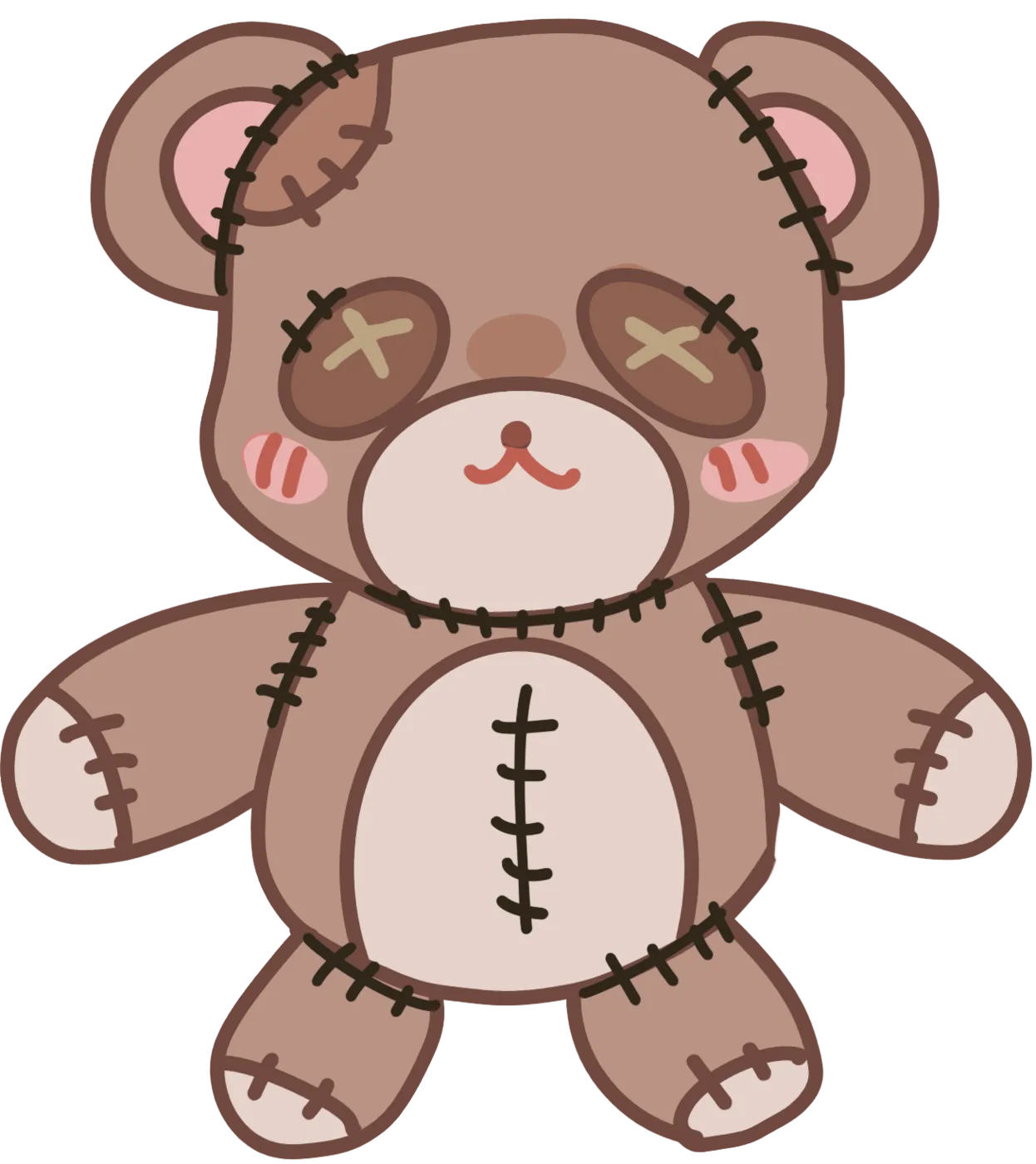
This is where the first minigame starts: point, click and drag with the mouse, pulling old dolls apart piece by piece into the bins. The teddy bear on the table is the first one. There is no timer and no fail state, because it is not a challenge but a chore, and the game wants you to feel how tedious and how intimate that chore is.
The teddy bear is not anonymous. Madison is an orphan Adrian talks about, abandoned at an orphanage at two and struggling to talk with the other children. She named the bear Adrian made for her Macaroni and carries it everywhere. She is the emotional anchor of the doll job and the first hint that the dolls have a purpose beyond Adrian's convenience.
-
The green dinosaur and the four names
Adrian brings home a green dinosaur and asks you to name it. There are exactly four options, and the game records whichever you pick: O'Green, Jeff the dark-lord of the darkness realm, Diny the bed-watcher or Bob.
It is a small character moment that says more than it looks. You are naming a thing that is going to end up in the bins with the others, and the game makes you do it cheerfully. All four are funny, and Jeff the dark-lord of the darkness realm matches Adrian's energy exactly.
Midnight 1: the pill
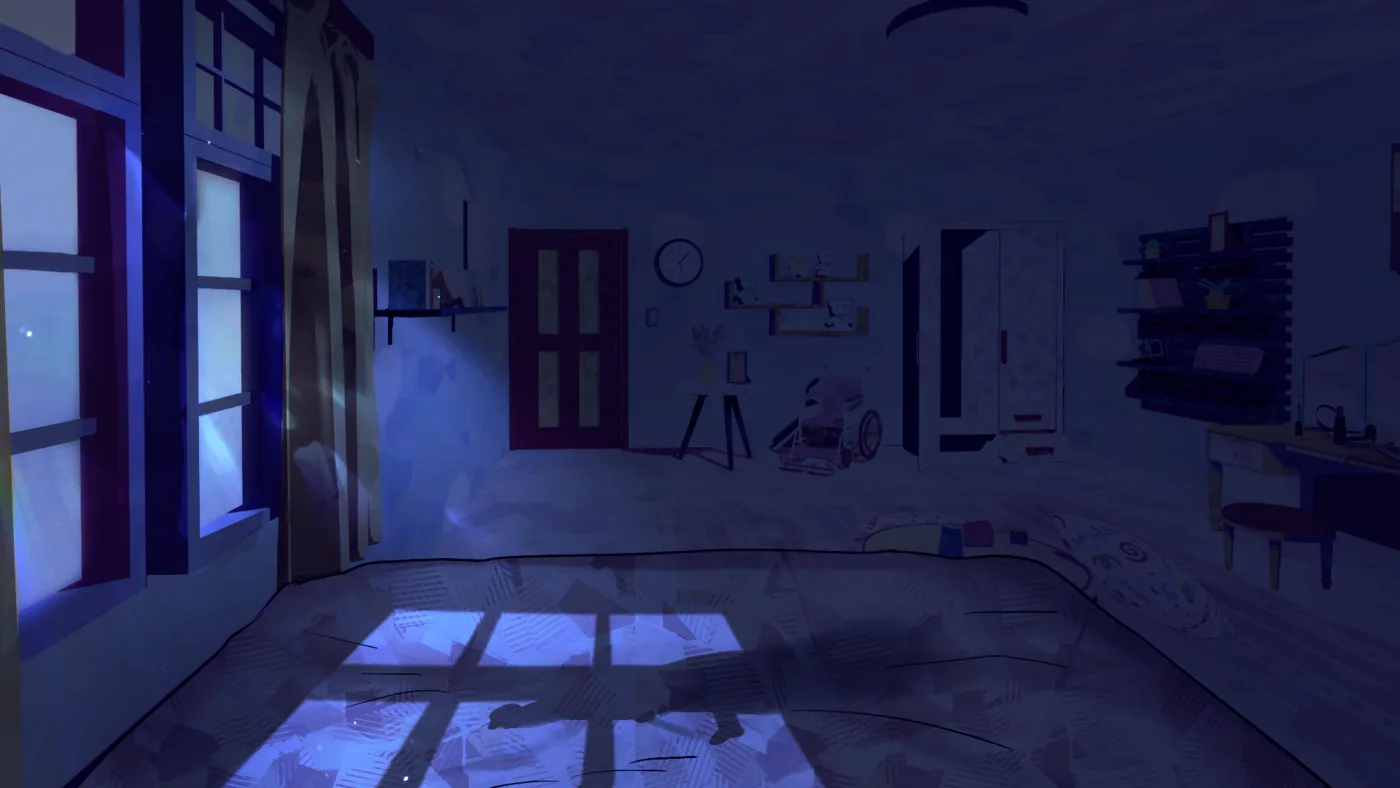
Two things happen at once, and the second is the reason the first works. A weight settles on you in the dark. A man's shadow falls across the bed. Then a hand clamps over your mouth and a pill is held in front of your face. The stranger is introduced only as ???: a young man in a hospital-patterned shirt, brown-haired and sharp-eyed, alternating between mocking and genuinely shaken.
The midnight scene carries four labels, and reading them tells you the whole structure of the choice. Three of them are things you can do in the room. #OpenEyes is your reaction to the shadow falling over the bed. Then the pill itself is handled by a PillChoiceCommand with exactly two branches. #Take sets tookPill = true. #Refuse sets tookPill = false and routes the scene into #Vanish.
The part people get wrong
Refusing is not a way out. Refusing still advances the story — it sends you down a different path instead of out of the game. tookPill is a record of what you did, and the rest of the script reads it. There is no safe branch at the midnight, only a branch you have to live with.
Mechanically this is a timed decision under the weight of a body, and the inputs are unusual: the mouse and the keyboard both matter. A brief press reads, a held press confirms. You are being asked to hold a key down while somebody is holding your face, so a panicked tap is a decision made without reading it. The minigame and QTE guide has the exact controls.
Both reactions are worth playing. Taking the pill is the path where you trust the stranger, and where the horror becomes the game's central subject rather than a suggestion. Refusing is the path where you keep your own judgement and stay awake for what comes next. Neither is a mistake; they lead to different trouble, and the second midnight comes back to the same question with the stakes raised.
Day 2: awake and exploring
Day 2 begins at Day2Awake, and the summary the script gives it is deliberately flat: the routine continues. Read that as a warning. On Day 1 you were handed a job and a dinosaur. On Day 2 you are handed a house to walk through.
Explore is the first sequence where you choose where to look. It has a #Parcel branch, a #Photo branch and an #ExploreLoop. The loop matters: the house can be explored more than once, and returning to a spot you have already resolved is how the game grades how curious you are.
-
The parcel
The
#Parcelbranch setssawParcel, the object that carries the address and therefore decides whether you can ever leave the house. Separately, the game tracks amadeupflag: you made up an excuse about where you were. It is the game asking whether you are the kind of partner who covers for Adrian. -
The newspaper headline you never finish
In the living room there is a newspaper whose headline is about a recent murder case, and you are interrupted before you finish reading it. The game will not let you read it. That denial is the point: the story wants you to know a murder case exists in this town without telling you what it is.
-
Adrian arguing with a man at the door
Adrian argues with a man who comes to the door. The game gives the man no name, no label and no introduction, and it cuts away before the argument resolves. You are left with two facts: Adrian has visitors he does not want you to know about, and this is not the kind of argument a doctor has with a neighbour.
-
Adrian's room and the family photograph
Then you walk into Adrian's room. There is a family photo on the wall with four smiling members in it, and the boy in the middle is Adrian. But his hair is black. Adrian is blonde. Nobody mentions it, and it sits on a wall in a room you are not supposed to be reading.
The room itself is the quieter half of that beat. You and Adrian are supposed to be together: you live in his house, you sleep while he works, you take apart his dolls for him. Nothing of yours is in his room. It has been emptied of you.
-
Searching the house
If you push on, the game eventually offers
Searching. It is gated on Adrian's approval: inStoryGame/Searching, anadrianRelationvalue above -3 routes to#NoSearch, blocking the branch outright. Low approval does not grey out the option, it removes it.


The address you have to keep
Here it is, written out in full, because this is the single most important detail in the game and the game itself never repeats it for you.
The safe place
742 Silverwood Creek Lane, Silverwood Springs, CA 95401
It is written on the parcel Adrian brings home, and it is the address you give Ian when you set toldAddress. Without it, the escape door never opens.
Why it carries so much weight is simple. That address is the safe place, and the only person in the story who knows about it is Adrian. Handing it to Ian is the exact moment you stop being a person living in Adrian's house and start being a person with a way out of it.
Two mechanical notes. First, you have to find the parcel, which is the #Parcel branch inside Explore and sets sawParcel. Second, you have to actually say the address to Ian. toldAddress is the flag that matters; an address sitting unread in your head does nothing. The secret room and escape guide covers the full sequence.
The phone and the two digits on your arm
Two digits of a phone number are written in ink on your arm. They fade over time, but you remember two of them, and you have to remember them in order to dial Oliver. That is the whole mechanic.
Oliver Freeman is the voice on the phone and the person who rescues you at the worst moment. He introduces himself on the phone as Oliver Freeman speaking. When Ian raises a syringe in the rain, Oliver is the one who stops it, having climbed over the fence just in time, and he says he is an officer of the law. Later you learn he had been parked in the alley by Adrian's house, patrolling day and night because he suspected Adrian.
The phone is a minigame in PhoneOutside1, after the escape. Four flags branch off that one screen, and all four change something: phoneTried for attempting a number at all, phoneCorrect for dialling the right one, phoneLeave for leaving the phone without calling, and oliverCallDropped for dropping Oliver's call.
Write the digits down. Genuinely. The ink fades and the game is not going to offer them a second time, and the difference between Oliver arriving and Oliver not arriving is the difference between two of the four endings.
LoverTime2: the intimate scene
LoverTime2 is the intimate scene with Adrian, and it has two branch labels at the end of it: #MakeupEnd and #Meds. This is the scene where the approval meter stops being abstract.
Every dialogue choice adds to or subtracts from Adrian's approval. Warm answers are worth up to +2, cold or resistant answers down to -2, and the meter decides whether Adrian hands over the medication in good spirits. The two labels read as two versions of the same night: #Meds hands you something to take, #MakeupEnd closes without. Which one you reach depends on how you have treated him.
Day2Evening: the medication, and the real fork in the story
Day2Evening is where Adrian hands you the medication before bed. It is the first genuine fork in the plot, and it has three ways through. The order of the script checks is the order that matters.
1. The !wentOutside conditional
First check. If wentOutside is false, the scene routes to #Trusting. One word, and it names your entire relationship. Never having left the house is what makes you trusted, and being trusted is what keeps you inside.
2. The spatPill check
Second check. If you spat the pill out, the scene changes and you go to Midnight2, where the pill scene is revisited and the story turns on the fact that you never actually swallowed it. spatPill is set by pretending to swallow and spitting the pill out.
If neither applies, the scene falls through to StoryGame/Midnight2 and then to Day3_ED1. That last one matters, because Day3_ED1 is where Ending 01 lives: it is reached when you have not gone outside and you accepted the medication Adrian handed you. The most trusting version of you walks into the worst ending, and the game never warns you.
The three options in plain terms: take the medication and go to sleep; pretend to swallow the pill and spit it out, which sets spatPill and routes to Midnight2; or be routed into #Trusting because you never once left the house. Only one is the game's idea of trust, and it is not the one that gets you out.
Day 3 and Day3_Act2: the knife
Day3_Act2 is the act two decision point and it splits on a single boolean. When useKnife is true, the scene routes to StoryGame/Attack1. When it is false, the scene routes to StoryGame/ICanFixHim. Both of those names are the game being honest with you about what it is proposing, which is unusual and rather effective.
The knife is not produced for the occasion. There is a separate flag, hasScalpel, for picking up the scalpel, and the game lets you carry it for a while before you decide what to do with it. The object is available, the decision is later, and the two are tracked independently.
Attack1 has an #A1_after label and leads into Attack2, which leads to FinishHim. The tension here comes from the quick-time events rather than the dialogue, and it is where most first runs fall apart. The escape sequence has its own entry point, Attack4, which leads into LockingDoor2. The game also keeps three game-over variants, GameOver1, GameOver2 and GameOver3, the last with that bodytype == "fem" branch.

The escape: LockingDoor2
LockingDoor2 is the escape sequence, and it runs on a strict order of checks. Knowing the order is the difference between getting out and being stuck in a loop. The script checks one thing at a time and the first that is true wins, so the order below is the logic.
-
clickedLivingDoorgoes to#ExitFirst check. If you already tried the living room door on the run, the scene goes straight to
#Exit. Clicking that door, even as a failed attempt, is worth doing early. -
hasKeygoes to#KeyDoorSecond check. If you are holding the key to the locked room, that is where the scene goes. The basement minigame opens its
#KeyStubbranch when that flag is set. -
Otherwise
#ClickLoopThird check, and the fallback. With neither the click on the living room door nor the key in your hand, the scene loops on the clicking, and the loop is where the game asks you again.
-
secretRoomVisitedgoes to#KeyDoorOpenFourth check. Having been inside the secret room behind the locked door opens the way past it.
-
Then
StoryGame/PhoneOutside1Fifth. You get to the phone either way. What changes is what you do once you are holding it, and the four phone flags are where that decision is recorded.
-
toldAddressdecidesOutside2againstOutside1Finally. If
toldAddressis set, the scene routes toStoryGame/Outside2. Without it, the scene routes toStoryGame/Outside1. That single condition is the whole game in one line.
Outside1 is where you meet Ian in the rain, and without toldAddress it leads to Ending 02, The cage. Outside2 is where you go further, and it splits one last time on Ian's affection: ianRelation at 40 or higher routes to StoryGame/IanRoute2 and Ending 04, anything lower routes to StoryGame/Police1 and Ending 03. Police1 is the police arriving and chasing Adrian; Police2 is the police arriving after the Ian route.
Ian's own route, IanRoute1, unlocks when ianRelation is above 14, and it has #FreeTime and #FlowerShop branches. The flower shop is the one part of Ian that turns out not to be a lie: his dream is to open one.
The four endings
All four routes are listed below in the order the game reaches them. The all endings guide goes deeper on the exact conditions, and the characters and story guide unpacks the family photograph.
My boyfriend is the best
The Adrian route. Keep his approval high, swallow the medication and stay inside. It is reached from StoryGame/Day3_ED1, which Day2Evening routes into when you have not gone outside and you accepted the medication he hands you.
A newspaper praises Dr. Adrian Winchester publicly and gives him the Outstanding Physician for Innovation and Medical Diagnostics of the Year award, noting that the brilliant 30-year-old physician is still a bachelor. The surface stays perfectly pleasant, and the story ends before the horror does.
The cage
The Ian route without commitment. You leave the house but do not give Ian the address, so LockingDoor2 routes to StoryGame/Outside1. Ian says there is nowhere else that is safe except that house, exactly as Adrian told you, and calls you a fool. You go back inside with him.
The escape that returns you to the cage. Ian is right about the house and wrong about what to do about it.
The Empty Cage
The escape route without Ian's full commitment. Reached from StoryGame/Police1, which Outside2 routes into when toldAddress is set but ianRelation is below 40.
Three months later you are in hospital, and it has been revealed that Adrian is a serial killer who kidnaps people and has them perform his dissections. Adrian is missing. The police raided the house and found nothing but bloodstains. Ian is also missing. Oliver visits you constantly, because he had been parked in the alley by Adrian's house, patrolling day and night because he suspected Adrian.
It is the safest ending and the loneliest: you are free of Adrian and you have lost Ian too.
Moving Forward
The escape route with Ian's full commitment. Reached from StoryGame/Police2, which IanRoute2 routes into when ianRelation is 40 or higher.
The same three-months-later frame as Ending 03, with one difference: Ian was sent to a psychiatric hospital nearby, and doctors sometimes let him use a mobile phone. The two of you call each other from time to time, and he is an even better speaker on the phone than face to face. Adrian is still missing.
It is the only ending where somebody is still talking to you.
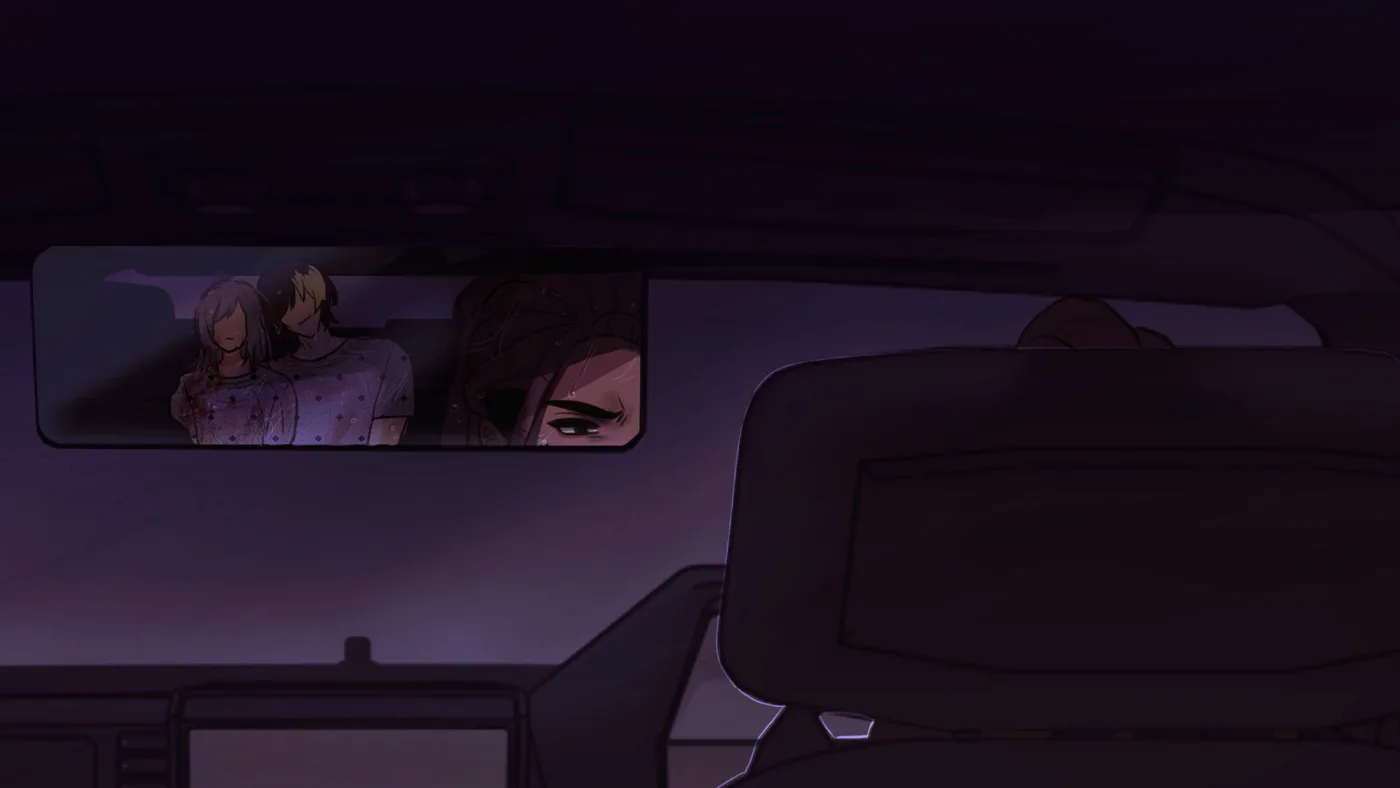
After the ending card comes the credits screen, EndCredit. Reaching any ending at all sets g_clearedOnce, marking that you have cleared the game once.
Missable details checklist
Every optional flag the script tracks, and what it changes. None are required to finish, but several quietly gate entire branches. The choices and flags guide covers the meters in detail.
tookPill— You swallowed Ian's pill on the first night. Set by the#Takebranch and read by the rest of the story.wentOutside— You left the house at least once. The!wentOutsideconditional inDay2Eveningroutes to#Trusting.sawParcel— You found the parcel Adrian brought home. Set by the#Parcelbranch inExplore, and the parcel carries the address.spatPill— You spat the pill out. It changesDay2Eveningand routes the scene toMidnight2.hasScalpel— You picked up the scalpel. It is the object theuseKnifedecision inDay3_Act2turns on.hasKey— You are holding the key to the locked room. InLockingDoor2it routes to#KeyDoorinstead of#ClickLoop.toldAddress— You gave Ian the address of the safe place. The escape door opens on this flag.clickedLivingDoor— You tried the living room door on the run. It is the first check inLockingDoor2and sends you to#Exit.secretRoomVisited— You have been inside the secret room behind the locked door. It routes to#KeyDoorOpen.phoneTried— You tried to dial a number on the phone.phoneCorrect— You dialled the correct number. This is the one that reaches Oliver.phoneLeave— You left the phone without calling.oliverCallDropped— You dropped Oliver's call.madeup— You made up an excuse about where you were.ftHereAsked— You asked whether Ian is here.ftKnowAsked— You asked Ian whether he knows something.ftAgeAsked— You asked Ian his age.ftEscapeAsked— You asked Ian about escaping.useKnife— You used the knife.Day3_Act2routes toAttack1when this is true and toICanFixHimwhen it is false.g_clearedOnce— Set after any ending is reached. It marks that you have cleared the game once.
FAQ
Should I take the pill that Ian holds out on the first midnight?
Either choice advances the story, so neither is a mistake. The pill decision is a PillChoiceCommand with two branches: the Take branch sets tookPill to true, and the Refuse branch sets tookPill to false and routes into the Vanish label. Refusing sends you down a different path.
What is the address I have to remember in Helping Your Boyfriend?
742 Silverwood Creek Lane, Silverwood Springs, CA 95401. It is written on the parcel Adrian brings home, found in the Parcel branch of the Explore sequence. You then give it to Ian, which sets the toldAddress flag, and the escape door in LockingDoor2 only opens on that flag.
How do I reach the ending called Moving Forward?
You need the escape route rather than Adrian's route, which means toldAddress has to be set. From Outside2, an ianRelation value of 40 or higher routes to IanRoute2 and on to Police2, which produces Ending 04. Below 40 you get Police1 and Ending 03.
What happens if I refuse Ian's pill instead of swallowing it?
The Refuse branch sets tookPill to false and routes the midnight scene into Vanish, and the story keeps going. The flag is a record of what you did. The same choice comes back at Midnight2, reached from Day2Evening when you spit the pill out instead of swallowing it.
Do I have to accept Adrian's medication on the evening of Day 2?
There are three ways through Day2Evening. You can take the medication, you can pretend to swallow the pill and spit it out, which sets spatPill and routes to Midnight2, or the not-gone-outside conditional routes you to Trusting. The script checks wentOutside first, then spatPill, otherwise falling through to Midnight2 and then Day3_ED1.
Does Helping Your Boyfriend have a good ending and a bad ending?
No. There is no official good or bad ending classification. The four endings split along how much you trust Adrian, how much you trust Ian, and whether you ever get out of the house.
What are the four endings called?
They are My boyfriend is the best, The cage, The Empty Cage and Moving Forward. The first two belong to Adrian's route and the last two to the escape route.
How do the two relationship meters change the story?
Every dialogue choice adds to or subtracts from Adrian's approval, with warm answers worth up to plus two and cold or resistant answers down to minus two. The meter decides whether Adrian hands over the medication in good spirits. Ian's affection opens his route above 14 and unlocks Ending 04 at 40 or higher.